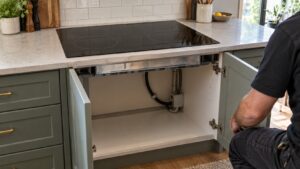
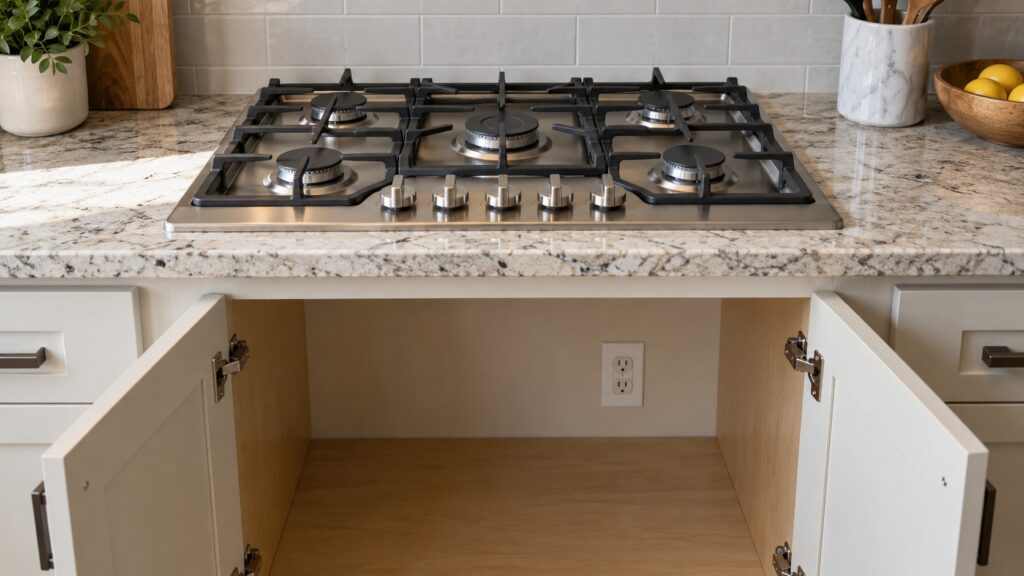
A Wolf gas cooktop dedicated circuit is not a strict requirement of the burners themselves, but the cooktop does need a working, properly grounded 120-volt supply, and the safest way to guarantee one is to give it its own circuit. The gas does the cooking, while electricity runs the spark igniters and the electronic controls, so a weak or shared supply shows up as burners that will not light or keep clicking. Your installation manual and local electrical code have the final say on the circuit size and whether it must be dedicated, so show both to your electrician before anything is wired.
Does a Wolf gas cooktop need electricity at all?
Yes, a small amount, and it is the part people forget. A Wolf gas cooktop lights its burners with electric spark igniters. When you turn a knob to light a burner, the ignition system sends a rapid series of sparks to the burner until the flame catches. The electronics also drive any indicator lights and, on some models, the ignition control that watches for a flame. With no electricity, the burners generally will not light with the knob alone, and the cooktop will behave as though it has no spark.
That is why a gas cooktop that is flawless on the showroom floor can misbehave in a new kitchen. The gas connection is only half of the installation; the other half is a clean, grounded outlet. Our Wolf cooktop installation guide covers the full opening, clearances and connections.
Does it need its own dedicated circuit?
The wiring rules come from the installation manual for your exact model and from your local electrical code, so read both rather than relying on a general answer. As a working rule, we recommend a dedicated circuit for any gas cooktop. A cooktop on its own breaker cannot be browned out by a garbage disposal, a dishwasher or a microwave starting up, and a tripped breaker elsewhere cannot silently switch off the igniters.
The reverse also holds. An ignition system sitting on a circuit shared with a motor can see voltage dips every time that motor starts, and the result is a burner that clicks but does not catch, or a control that flickers. Those faults are intermittent and infuriating, and a dedicated circuit removes them from the list of suspects. Your electrician will also tell you if your code requires ground-fault protection on that outlet, which is a decision for them and not for the cooktop.
What outlet and wiring does the cooktop use?
A Wolf gas cooktop uses a standard grounded 120-volt connection. The ground matters more than people expect. Ignition electronics rely on a good ground to work reliably, and a missing or poor ground can cause clicking that never stops or a spark that is weak and sporadic. A reversed outlet, where hot and neutral are swapped, can cause similar trouble. Have the outlet tested with a proper tester before the cooktop goes in, not after.
Do not use an extension cord, a power strip or an adapter that defeats the third prong. Those are fire risks next to a heat source, and they introduce exactly the weak ground the igniters dislike. If the cord will not reach the outlet, the right answer is a new outlet in the right place, installed by a licensed electrician.
Where should the outlet be placed?
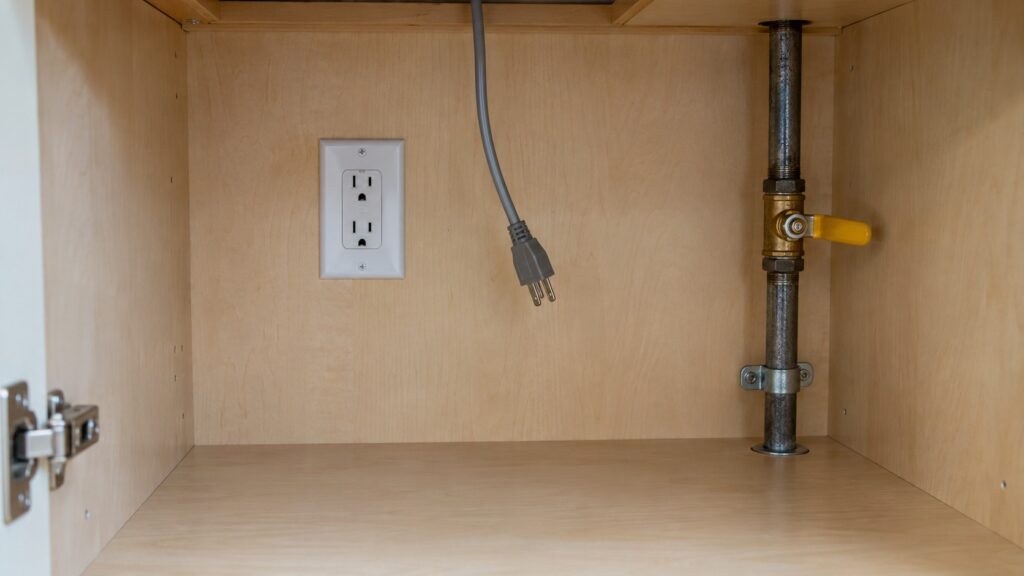
Put it where the cord can reach it without stretching and where it is safe from heat, grease and the gas line. In most installations the outlet goes inside the cabinet below the cooktop, off to one side of the opening, away from the burner box and well away from the gas flex connector. Your manual shows the allowed zone for the outlet and the length and route of the cord, and those drawings are worth printing and handing to the electrician and the countertop installer together.
Plan for service access as well. If the outlet is buried behind the cabinet face or covered by the countertop, a technician has no quick way to unplug the cooktop, and unplugging is the first step of nearly every safe repair. A reachable outlet is a small detail that saves a lot of trouble later.
How is this different from a Wolf induction or electric cooktop?
It is a different class of supply entirely. Induction and electric Wolf cooktops draw a large load and need a 240-volt circuit sized to the model, while the gas cooktop needs only the small 120-volt supply described above. Do not assume the two have anything in common. If you are comparing, our guide to Wolf IR range electrical requirements shows how large the induction circuit is, and our induction cooktop installation guide covers the rest.
The gas supply has its own rules for the shutoff valve, the flexible connector and, on propane, the regulator. That is a licensed professional’s job, and it is explained in our guide to the Wolf gas line and regulator.
What symptoms point to a supply problem?
A new installation that will not light at all, a display that is dark, burners that click without catching, or igniters that click continuously even after the flame is on can all trace back to the electrical supply. If the cooktop was fine yesterday and dead today, check whether a breaker or a ground-fault outlet has tripped, because a gas cooktop with no power looks exactly like an igniter failure.
When the supply is sound and the symptoms persist, the cause is in the cooktop. Our guides to a Wolf gas cooktop that won’t light and to continuous clicking take over from there, and our Wolf cooktop repair page describes a visit.