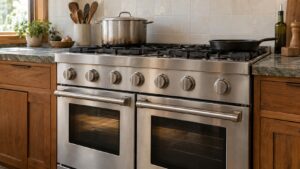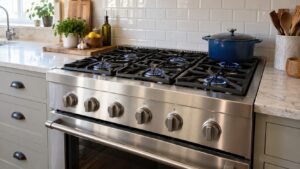
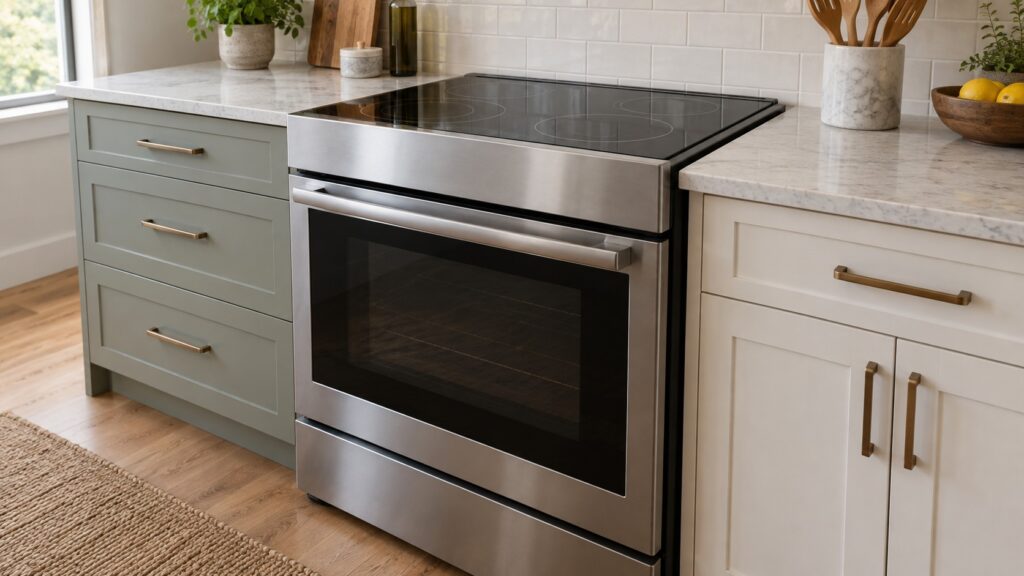
A Wolf IR-series range puts an induction cooktop and a full oven cavity in one freestanding cabinet, and that combination changes the electrical planning compared with a standalone induction cooktop or a gas range. Wolf ir range electrical circuit sizing has to account for a single circuit carrying the cooktop’s induction elements and the oven’s convection and bake elements running together, not for either load on its own — which is exactly the kind of detail that gets missed when a kitchen remodel reuses an outlet sized for the range it is replacing.
Why does a Wolf IR range need a bigger circuit than a standalone induction cooktop?
A cooktop-only induction installation only has to power the cooking surface. An IR range’s single circuit has to carry that same induction load plus the oven’s bake and broil elements, and because the range’s control logic can run both at once — searing on the cooktop while the oven preheats — the circuit has to be sized for that combined draw, not for whichever load happens to be larger on its own. This is the single most common mismatch on a kitchen remodel: a contractor reuses the amperage from the gas range being removed, and it comes up short for the IR model going in.
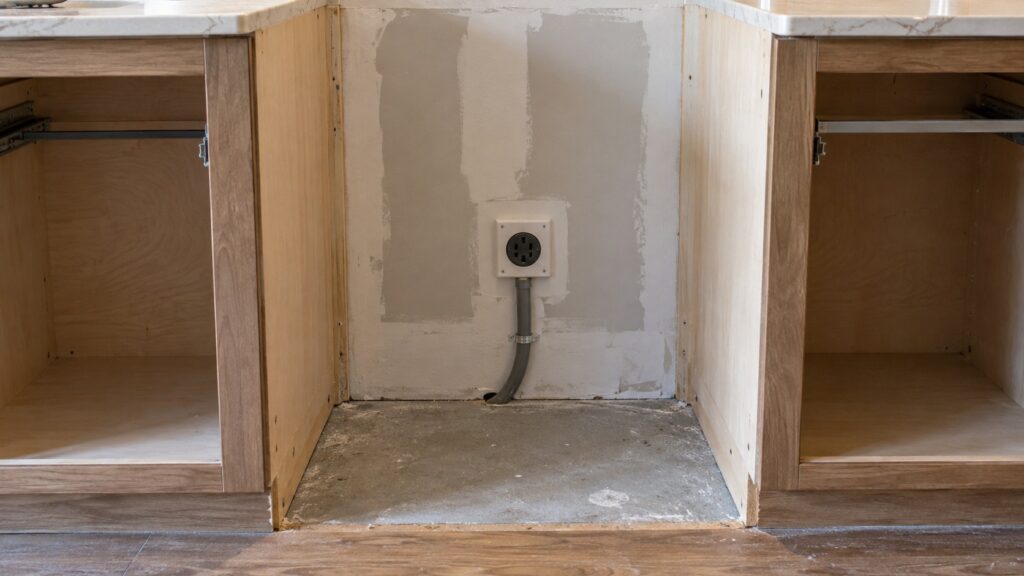
Does the 30-inch IR need the same circuit as the 36-inch model?
No. The wider 36-inch IR carries a larger cooktop surface with more induction elements and a proportionally larger oven cavity, and its nameplate amperage reflects that. Sizing a 36-inch IR range on the smaller model’s 40-amp circuit will trip the breaker under a combined cooktop-and-oven load, typically at the worst possible moment — mid-cook, with a dinner on both. Always confirm amperage against the specific model’s own nameplate rather than assuming both widths share a rating.
What has to be true about the space behind the range before it arrives?
The receptacle needs to sit at a height and depth that lets the range’s own power cord reach it without stretching or kinking once the range is pushed into its final position — most installers rough-in the outlet slightly off-center from the cabinet opening specifically so the cord clears the range’s rear support bracket. Ventilation and gas supply are not part of this circuit at all on an IR model, since induction cooking has no gas line and no combustion venting requirement the way a gas or dual-fuel range does; the only utility connection an IR range needs is this one dedicated electrical circuit.
How does this compare with installing a standalone Wolf induction cooktop?
A drop-in induction cooktop on its own typically draws less than a full IR range, because it has no oven load sharing the circuit. Our how Wolf induction cooktops work guide covers the underlying induction technology shared by both the standalone cooktop and the IR range’s cooktop section, and our general Wolf induction cooktop installation guide covers the countertop-cutout side of a standalone unit — useful background, but not a substitute for sizing the IR range’s own combined circuit correctly.
Does the delivery crew need anything special for an IR range compared with a gas model?
Because there is no gas line to cap or connect, delivery and set-in for an IR range is generally more straightforward than for a gas or dual-fuel model — there is one utility connection to make rather than two. That said, the range itself is not necessarily lighter than a gas equivalent, since the induction elements and their control electronics add weight of their own, so the same care around floor protection and doorway clearance during delivery still applies.
What about clearance to cabinetry and combustible surfaces?
Because the IR range has no open flame, side clearance requirements are less strict than for a gas range, but the nameplate still specifies a minimum distance to adjacent cabinetry to protect against radiant heat from the oven section during long roasts and self-clean cycles. Leveling the unit correctly on delivery also matters more than it does on many ranges, since an unlevel induction surface can affect how evenly a pan makes contact with the coils underneath it.
Who actually decides the final circuit amperage — the nameplate or a rule of thumb?
The nameplate on the specific unit being installed is the only reliable source, and it always overrides any rule of thumb passed along from a previous installation or a different range brand. Amperage ratings on induction ranges can differ between model years even within the same nominal width, since a control refresh or an added feature can shift the combined draw slightly. An electrician sizing the circuit from a spec sheet downloaded years ago, rather than the nameplate on the unit actually being delivered, is a preventable source of an undersized circuit that only shows up once the range is in place and running a full load.
Local electrical code also has the final say on breaker sizing and wire gauge, and it can be stricter than the manufacturer’s stated minimum depending on the run length from the panel and the jurisdiction’s own requirements. Getting a licensed electrician to confirm the circuit against both the nameplate and local code before the wall is closed up avoids a rough-in that passes a casual glance but fails inspection or, worse, fails under real cooking load after the kitchen is finished.
What should be confirmed before the range is set into place?
Verify the breaker amperage and receptacle type against the exact model number — 30-inch and 36-inch IR units are not interchangeable on the same circuit — and confirm the rough opening depth accounts for the cord and strain relief at the back. For the range’s general electrical and ventilation requirements beyond the induction-specific points here, our Wolf range installation guide covers the shared baseline that applies across the Wolf range lineup.
We are an independent installation and repair service, not a factory-authorized channel, and we verify circuit sizing against the specific IR model before a new range goes in. If you are planning an IR installation or troubleshooting one that was set up incorrectly, Wolf range repair covers both, and you can schedule a visit with the model number in hand.