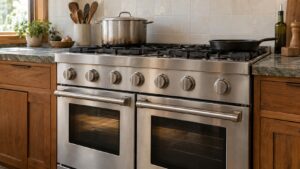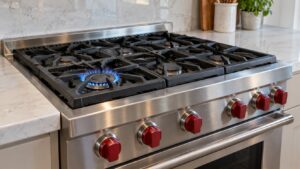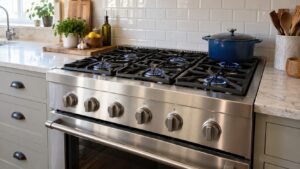
Wolf gas range gas line requirements come down to four things: a shutoff valve you can reach, a connector approved for the job, a supply sized for the appliance’s total burner load, and a leak test before anyone cooks. The details live in the installation manual for your exact model, but the checklist below covers what a homeowner should confirm with the installer before a Wolf gas range or dual-fuel range is pushed into place. Gas work must be done by a qualified, licensed professional, and nothing here is a do-it-yourself guide.
What does a Wolf gas range need from the gas supply?
A gas range is the largest gas load in most kitchens, and a Wolf range is built with powerful burners, so the line behind it has to deliver enough gas when everything is lit. That is a question of pipe size, run length and what else shares the line. A supply that is fine for a modest cooktop can be marginal for a dual-fuel range with a gas oven and several high-output burners, and the usual symptom of an undersized line is a flame that sags when a second burner or the oven comes on. Ask your installer to size the line for the specific model, not for a generic range.
Look at the manual for the burner and oven ratings and give them to the person running the pipe. If your kitchen is being remodeled, this is the cheapest time to correct the line. Our Wolf range installation guide covers clearances and the anti-tip bracket, and the gas line is the other half of the job.
Where should the shutoff valve go, and what connector is correct?
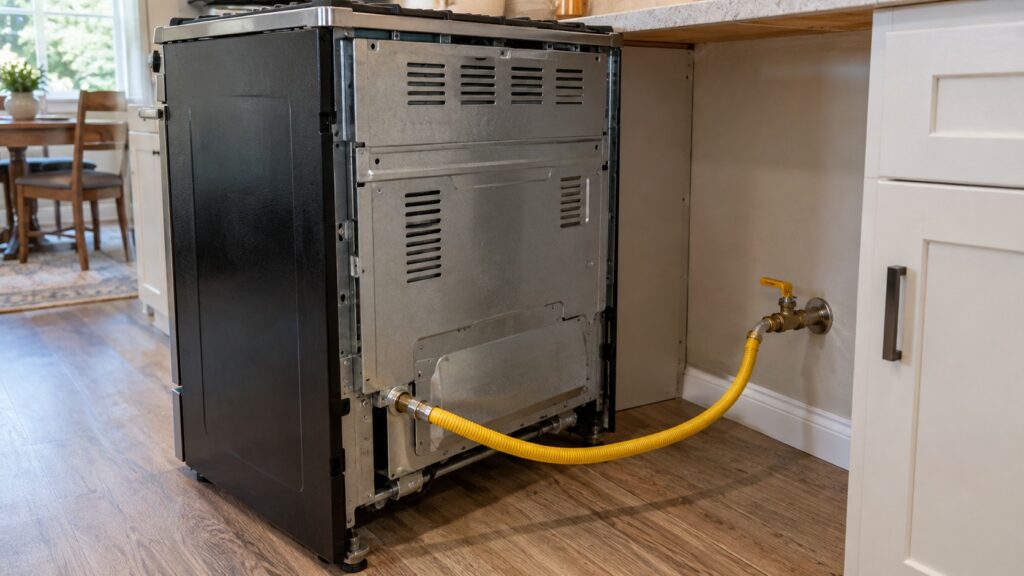
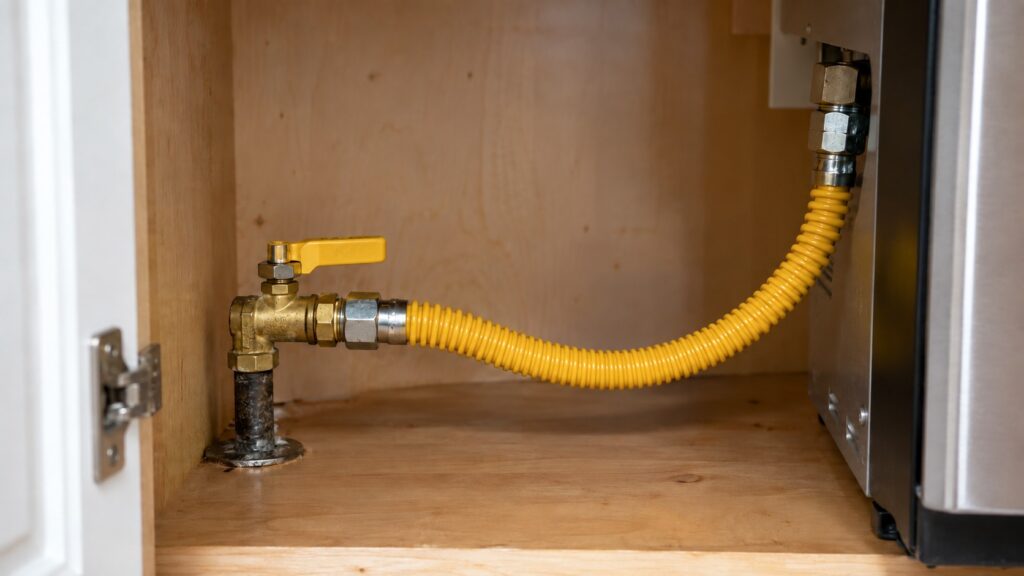
The shutoff valve needs to be somewhere you can reach it in a hurry, ideally in the cabinet next to the range or in the wall behind it at a point that stays accessible. A valve hidden behind a range that cannot be pulled out is a safety problem, because the first thing anyone should do in a gas emergency is shut the supply off. If the valve is behind the range, the connector must be long enough to let the range come forward, and the installer should leave the pull-out path clear.
The connector itself should be a flexible gas appliance connector approved for the application, not a repurposed hose of unknown origin. It should reach without kinking or being pinched against the wall, and it should not be stressed by the range being pushed back. An old connector from the previous range is not a bargain. Reuse is discouraged by many manufacturers, so check the manual and ask your installer to fit a new one.
Natural gas or propane: what must you confirm before delivery?
Ranges are set up for one fuel at a time, and running the wrong fuel through the wrong orifices is dangerous. A natural gas range needs different orifices and pressure settings than a propane one, and some models ship configured for one and need a conversion for the other. Confirm the fuel your house actually uses, confirm what your range is configured for, and tell the installer both. A mismatch is not a small annoyance; it can produce a poor flame, soot, or unsafe combustion.
If you have propane, make sure whoever supplies the tank and regulator knows a range is being connected, since a house regulator must match what the range expects. Rangetops and cooktops share these concerns, and our Wolf rangetop installation guide and Wolf cooktop installation guide cover their specifics.
How is a new gas connection tested?
Every joint on the new connection should be checked for leaks before the range is used. Installers typically use a leak-detection solution or a gas detector on each fitting while the supply is on, and they watch for bubbles or a reading. This is not something to skip because the pipe “looks fine”. After the leak test, the installer lights every burner and checks that the flame is steady and blue at the base, then looks at the oven burner or igniter on a dual-fuel or gas oven. If a burner is yellow, noisy or lifting off the port, do not accept it as normal; ask for it to be corrected on the spot.
It is also worth testing the shutoff valve. Turn it to off and back on, and make sure it moves freely. A valve that is stiff or does not close fully should be replaced before the range is hooked up, because you want that valve working on the day you need it.
What should you do if you smell gas?
Treat it as an emergency. Do not turn lights or appliances on or off, do not use a phone in the room, and do not try to find the leak. Leave the house, then call your gas utility or emergency number from outside. Do not return until it has been cleared. This is the rule for a new installation as much as an old one, and it is why a proper leak test matters. Our page on a rangetop that smells of gas when off explains the follow-up once the immediate danger has been dealt with.