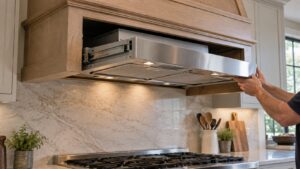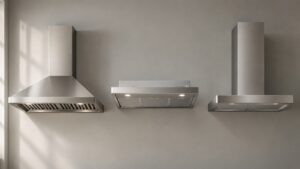
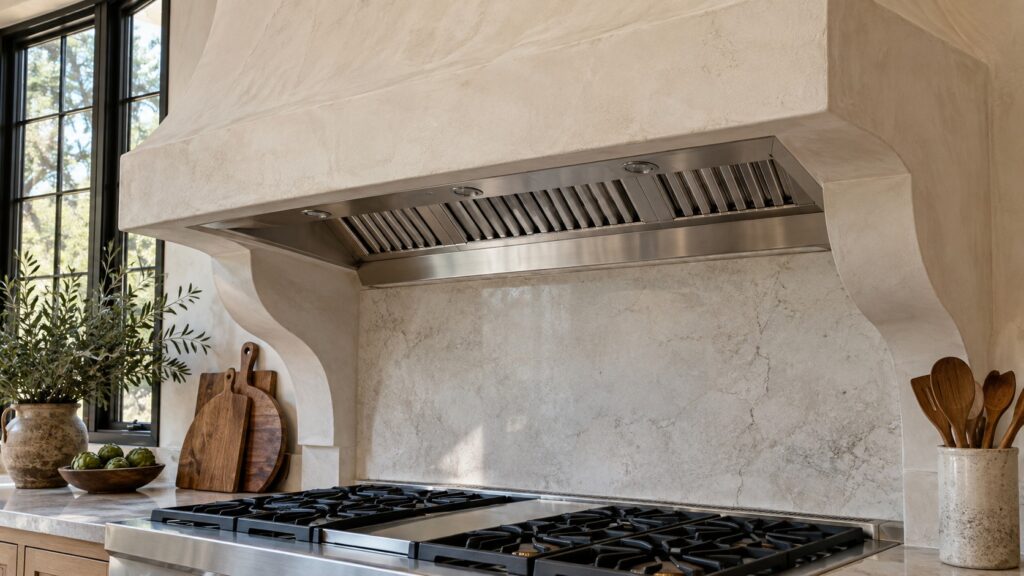
A Wolf PL462212 hood liner is not a hood you hang on a wall. It is an insert: a stainless housing with baffle filters, lights and a blower connection that gets built into a custom enclosure a cabinetmaker makes. The number beside it in our model list, PL461912, is the same idea in a shallower body, and the choice between the two is almost entirely a question of how deep the enclosure over your cooking surface will be.
What is a Wolf PL462212 hood liner, exactly?
A pro liner is the ventilation machine without the furniture. Everything that does the work is in it: the capture area, the baffle filters, the light housings, the controls and the opening the blower connects to. What it does not include is the box you see from the kitchen — that is built on site in plaster, wood or metal, and the liner drops into it from below.
People choose a liner for one reason: the hood has to look like part of the room rather than like an appliance. A custom enclosure can be plastered to match the wall, paneled to match the cabinets or built into a chimney breast, and the liner underneath does the ventilating. The tradeoff is that the enclosure has to be right before the appliance arrives, because there is nothing adjustable about a stainless insert.
If you have not settled on the liner approach at all, our Wolf range hood buying guide compares it against wall-mounted and island hoods that arrive finished.
How do PL462212 and PL461912 differ?
They share the family letters and the leading width block, and they differ in the block that follows. In a dimensional number like this one, that middle pair is the depth — how far the liner reaches from the wall out over the cooking surface — and it is the dimension that changes what the hood can actually capture.
Depth is not a cosmetic choice. Hot air and grease leave a cooking surface in a rising plume that spreads as it climbs, and a hood only captures what it stands under. A liner that stops short of the front burners lets the plume from those burners drift past the edge and into the room, no matter how much air the blower moves. The deeper body is what covers a deep professional rangetop; the shallower one suits a shallower cooking surface or an enclosure that cannot project as far.
The right way to make the decision is to measure the cooking surface, not the hood. Work out how far the front edge of your rangetop or cooktop reaches, and choose the liner that stands over it. Then confirm that the enclosure can be built that deep without becoming something people hit their heads on.
Which blower goes with a liner?
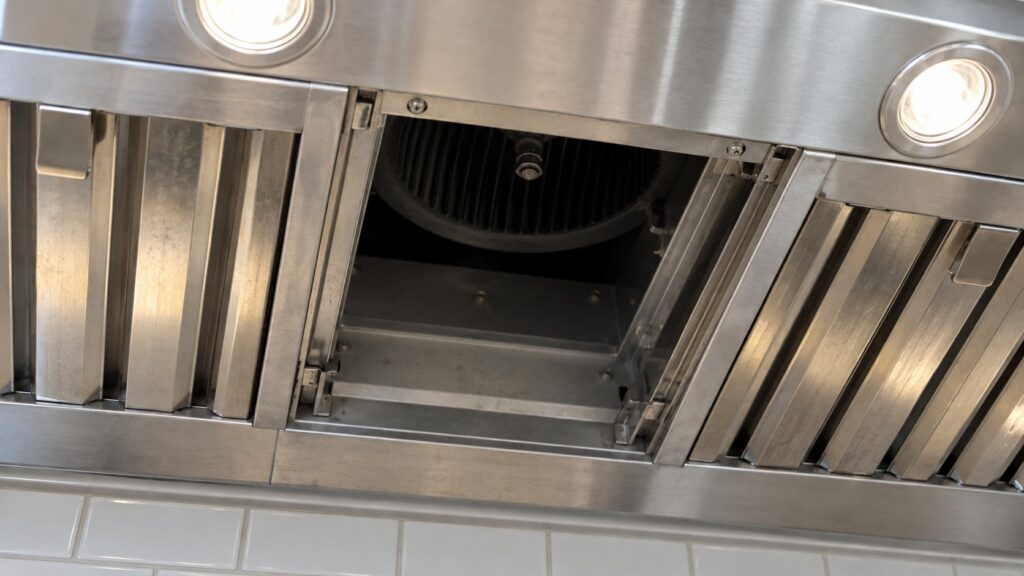
The liner and the blower are separate decisions, and this is where a liner project most often goes wrong. Three arrangements are normal, and each suits a different kitchen:
- Internal. The blower sits in the liner itself. Simplest installation, and the noise is in the room with you.
- Inline. The blower sits in the duct run, typically in an attic or a joist space. Quieter in the kitchen because the moving parts are away from it.
- Remote. The blower sits at the far end of the duct, often on an exterior wall or roof. Quietest indoors, and the most demanding to install and later to service.
Duct length, the number of elbows and the duct diameter all matter more than the number on the blower box. A powerful blower at the end of a long, kinked run moves less air than a modest one on a short straight duct. Our explanation of how a Wolf hood blower works goes through what the rating does and does not promise.
One more consideration belongs here rather than at the end of the project: a strong hood pulls air out of a tight house faster than the house can replace it, and the fix is planned in advance. Read the makeup air requirements for a Wolf hood before the ducting is finalized, not after.
What does the enclosure have to provide?
Four things, and none of them can be added later without cutting into finished work:
- An internal opening that matches the liner, with the clearance the appliance requires around it rather than a snug hole.
- Support that carries the weight of a stainless insert plus a blower, independent of the decorative skin.
- Access for service. Someone will eventually need to reach the blower connection, the light housings and the wiring. Plastering over that access is a decision you only make once.
- The duct path, sized and routed, including where it penetrates the ceiling or wall and how it terminates outside.
The mounting height above the cooking surface is set by the appliance below, not by the look of the room, and it is the number the cabinetmaker most often has to be given twice. Our range hood installation guide covers the clearances that apply.
What is service like on a built-in liner?
Ordinary maintenance is the same as any professional hood. The baffle filters lift out for cleaning, the lights are reached from below, and the filter reminders behave as they do across the range. If your hood prompts you with a filter reminder, our guide to the baffle filters and the FG and FC reminders explains what it is asking for.
Repair is where the liner differs. Because the appliance sits inside a built enclosure, reaching a blower, a light socket or a control depends entirely on how the enclosure was made. A liner installed with an access panel is straightforward to work on; one plastered in solid can turn a small repair into a building job. If you are specifying a hood now, that is worth a conversation with the builder before the work starts.
Is a liner the right choice for your kitchen?
Choose a liner when the enclosure is part of the design of the room and you are working with someone who will build it properly. Choose a finished hood when you want a known appliance on a wall, a predictable installation and simple future access. Both ventilate; they differ in how much of the result depends on carpentry.
Whichever way you go, decide the blower type and the makeup air strategy at the same time as the hood, because those three choices constrain each other. A Wolf PL462212 hood liner in a well-built enclosure with a properly sized duct will outperform a larger hood installed carelessly every time.
We are an independent repair company, not a factory service arm. Pricing starts from a diagnostic visit and we confirm the estimate before any work begins. If an existing liner has stopped pulling, a light is out or a blower has gone quiet, call (844) 991-2780 or schedule a visit — our Wolf range hood repair service works on built-in liners as well as finished hoods.