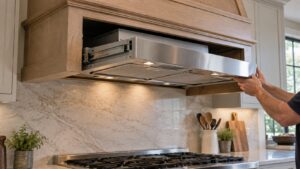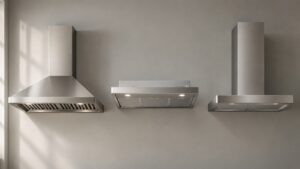
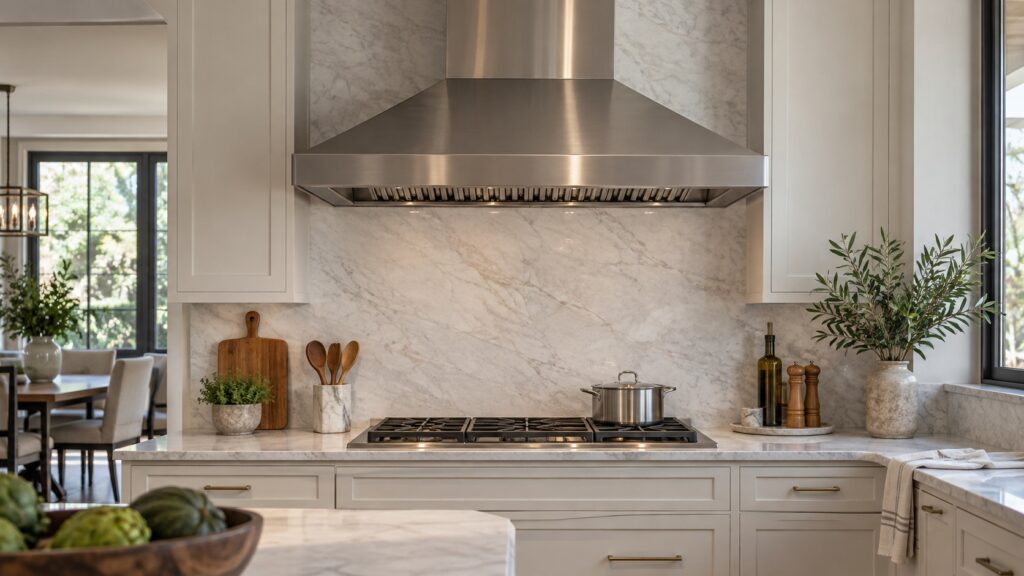
A professional-style hood moves a great deal of air, and every cubic foot it pushes outside has to be replaced from somewhere. In a modern, tightly built house there is nowhere for it to come from — so the wolf hood makeup air requirement is not an upsell, it is the thing that makes a powerful hood work at all, and in most jurisdictions it is required by code above a certain airflow.
Why a house resists a powerful hood
A hood is a pump. It removes air from the kitchen and pushes it outdoors, and the volume it removes must be replaced or the pressure inside the house falls below the pressure outside.
An older, leaky house replaces it without anybody noticing — air seeps in around windows, through the frame, under doors. A modern house is deliberately sealed, and there is no meaningful leakage path. The hood then finds itself trying to pull air out of a container, and what it actually does is run at full noise while moving a fraction of its rated airflow.
People report this as a hood that is not powerful enough, and buy a bigger one, which makes the problem worse.
The part that matters for safety
Air will come in somewhere, and if there is no designed path it uses whatever is available. In a house with a gas furnace, a gas water heater, a fireplace or a wood stove, the most available path is often the flue of one of those appliances — in reverse.
That is backdrafting, and it brings combustion products into the house rather than sending them out. Carbon monoxide is the reason this is written into code rather than left to preference. It is also why the threshold is expressed in airflow: below it, normal leakage copes; above it, it does not.
The everyday symptoms are milder and worth recognizing: exterior doors that are hard to open while the hood runs, a whistling at a door or window, a fireplace that smokes back into the room, and a hood that sounds powerful and clears nothing.
How makeup air is supplied
The principle is simple — a duct from outside into the house, opened when the hood runs — and the engineering is in the details.
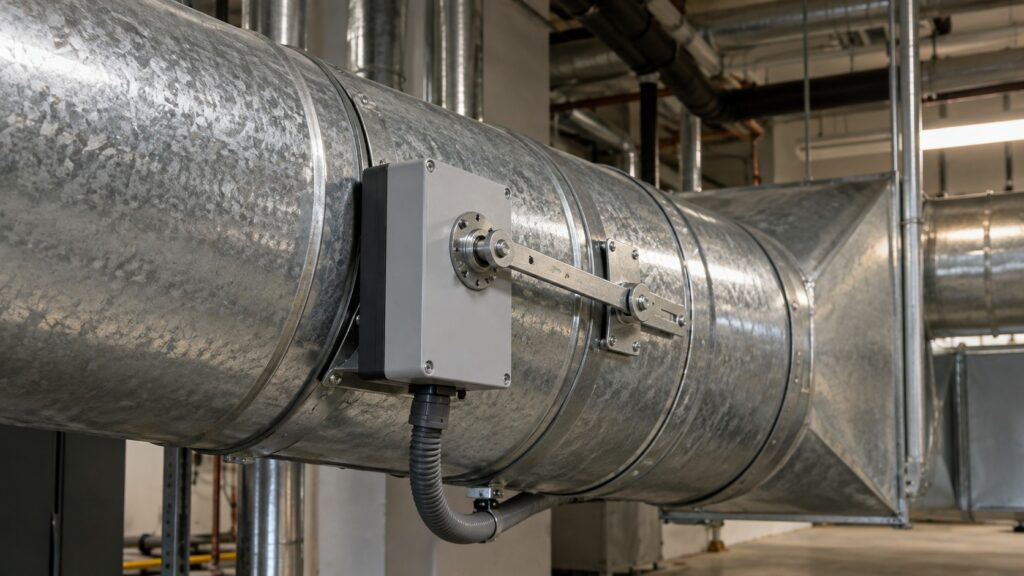
- A motorized damper opens the supply when the hood is switched on and closes it when it stops, so the opening is not a permanent hole in the building.
- Interlock ties that damper to the hood, usually electrically, so it cannot be forgotten.
- Tempering — heating the incoming air — is needed in cold climates, or the kitchen gets a blast of winter air at the worst moment.
- Delivery point matters. Air introduced badly creates a draft across the cooktop that disturbs burner flames and defeats the hood’s capture.
- Sizing is matched to the hood’s exhaust rate, not chosen by convenience.
This is mechanical contractor work, coordinated with the hood selection, and it belongs in the plan before the walls close.
The exhaust side still has to be right
Makeup air does not rescue a poor duct run. The exhaust duct should be rigid metal, sized to the hood’s requirement, as short and straight as the layout permits, and terminating outdoors with a cap that opens freely and has no screen.
Every elbow costs the equivalent of several feet of straight run. Undersized duct is the commonest reason a hood underperforms after everything else has been done correctly — a powerful blower pushing through a duct meant for a smaller one simply cannot move its rated air. Our vent setup guide covers sizing and routing, and the hood installation guide covers the mounting.
Mounting height and capture
The hood’s specified height above the cooking surface is a compromise between capture and usability, and it is model-specific. Too high and the rising plume spreads before it is caught; too low and it is a hazard over open burners and impossible to cook under.
Capture also depends on the hood being at least as wide as the cooking surface, and preferably wider on a professional rangetop where burners run to the edges. A hood narrower than the appliance below it will always miss what happens at the sides.
Signs you have a makeup air problem rather than a hood problem
Before assuming the blower or the ducting is at fault, look for the pressure signature. Does an exterior door become noticeably harder to open when the hood runs on high? Does a nearby door whistle? Does the hood perform noticeably better with a window cracked open?
That last test is the clearest one available without instruments. If opening a window transforms the hood’s performance, the house is the restriction, not the appliance. Our weak suction guide covers the other causes to rule out.
Retrofitting into an existing kitchen
It is harder but not impossible. The work is finding a route for the supply duct, fitting an interlocked damper, and tempering the air if the climate demands it. In a basement or crawlspace with access, it is a manageable job; in a finished second-floor kitchen it can mean significant disruption.
If a full installation is not practical, the interim measures are honest but limited: run the hood on a lower speed, open a window while cooking, and have any combustion appliances checked for correct draft with the hood running. None of those is a substitute for a designed supply.
When to call
Call when a hood underperforms despite correct ducting, when doors become hard to open or a fireplace smokes while the hood runs, when a makeup air damper does not open with the hood, or when the blower runs but moves no air. And have combustion appliances checked if you suspect backdrafting at all.
We are an independent repair company and not a factory service arm. Pricing starts from a diagnostic visit and we confirm the estimate before any work begins. Wolf range hood repair covers blowers, dampers, controls and lighting, and you can schedule a visit online.