

Wolf island hood cleaning follows the same logic as any hood, with one difference that changes the routine: an island hood hangs in the open over your cooking surface, so grease settles on every side of it and on the chimney above, and there is no wall to hide the mess. A proper deep clean takes about an hour. Switch the hood off at the breaker, take out and wash the baffle filters, degrease the underside and the interior you can reach, wipe the stainless with the grain, clean the lights, and then put everything back dry. Our model list includes island hoods such as the PI543418 and PI423418, and the steps below apply to the family.
Why does an island hood need a different cleaning routine?
A wall hood hides its back against the wall and its sides against cabinets. An island hood is a floating canopy: the underside, all four edges, the chimney and the top of the canopy are visible and exposed to rising grease vapor. The vapor that escapes the filters does not vanish; it condenses on the cool stainless and turns tacky, then collects dust from the room, which is why a neglected island hood looks dirty from the other side of the kitchen.
It also sits higher in the room and is surrounded by open space, so air currents carry grease further. Expect to clean more surface area than you would on a wall hood, and expect the top of the canopy to need attention that wall hoods never get. If you want the general schedule for any hood, our Wolf range hood maintenance guide has it, and this one adds the island-specific work.
How do you take out and clean the baffle filters?
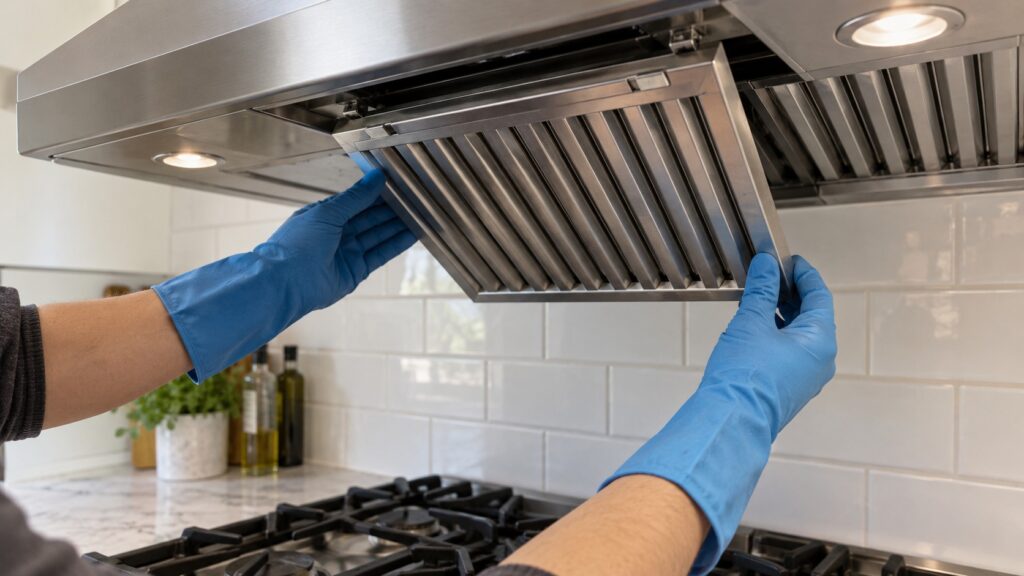
Start with the filters because they carry most of the grease. With the power off, release the baffle filters from the underside of the hood according to your manual, and support each one with your free hand as it comes out. Soak them in hot water with dish soap or degreaser for a few minutes, scrub gently with a soft brush along the slots, rinse well and let them dry completely before they go back.
Many stainless baffle filters can go through the dishwasher, but check your manual first, since finishes and washing advice can differ between hood models. Our guide to Wolf range hood baffle filters explains the filter reminder behavior, and the baffle filters glossary entry explains why this design catches grease better than a mesh filter.
How do you degrease the underside and interior safely?
With the filters out, you can see the grease that got past them. Wipe the underside and the interior surfaces you can reach with a cloth wrung out in warm soapy water or a degreaser made for stainless steel. Work in small sections so the cleaner never dries on the surface, and never spray directly upward into the opening where the blower sits. Spray the cloth, not the hood.
Stop at the blower housing. Do not push a wet cloth into the blower, and do not pour or spray liquid toward the motor or the wiring. If grease has built up so deeply that you can see it dripping from deeper inside, that is a job for a technician. Our guide to the Wolf hood blower shows what lives behind that opening and why it should stay dry.
How do you clean the stainless steel without leaving streaks?
Stainless steel has a grain, a faint direction of lines in the metal, and wiping across the grain leaves streaks and can show fine scratches. Wipe along the grain with a soft cloth, first with soapy water, then with clean water to remove the residue, then dry with a dry cloth. Use a stainless-steel polish only if your manual allows it, and apply it sparingly, because too much attracts fingerprints.
Do not use steel wool, abrasive pads or bleach, and avoid oven cleaner. Chlorine and strong caustics can pit or stain stainless steel. The chimney and the top of the canopy get the same treatment, and a long-handled microfiber duster before the wet cloth helps with the dust that has settled on top. A ladder should be on level floor and never on a rolling base.
What about the lights, the controls and the filter reminder?
Wipe the light lenses with a damp cloth once the lights are cool, and do not pull anything apart that your manual does not tell you to remove. If a light is out, our guide to Wolf range hood lights out sorts out whether the problem is the bulb, the switch or the supply. On the controls, use a barely damp cloth and dry immediately, since moisture behind a keypad is a common reason a hood starts misbehaving.
After the filters go back, reset the filter reminder if your model has one. Then run the hood on a low speed for a minute and listen. A smooth, even sound means the filters seated correctly. A rattle usually means a filter is not latched, and a new or louder noise that persists after cleaning deserves a visit.
When is cleaning not enough?
If the hood is clean but pulls weakly, the fault is somewhere else: a blocked duct, a closed damper, too little makeup air or a tired blower. Our guide to Wolf range hood weak suction lists those causes in order. If you need a hand, our Wolf range hood repair page describes what a visit covers.