Wolf oven uneven baking is one of the few complaints where the appliance is usually working correctly and the result is still wrong. Before any part is suspected, three things have to be ruled out: how the oven is loaded, how it is measured, and whether the door still seals. Only after those does it become a sensor, an element or a fan question.
Measure before you diagnose
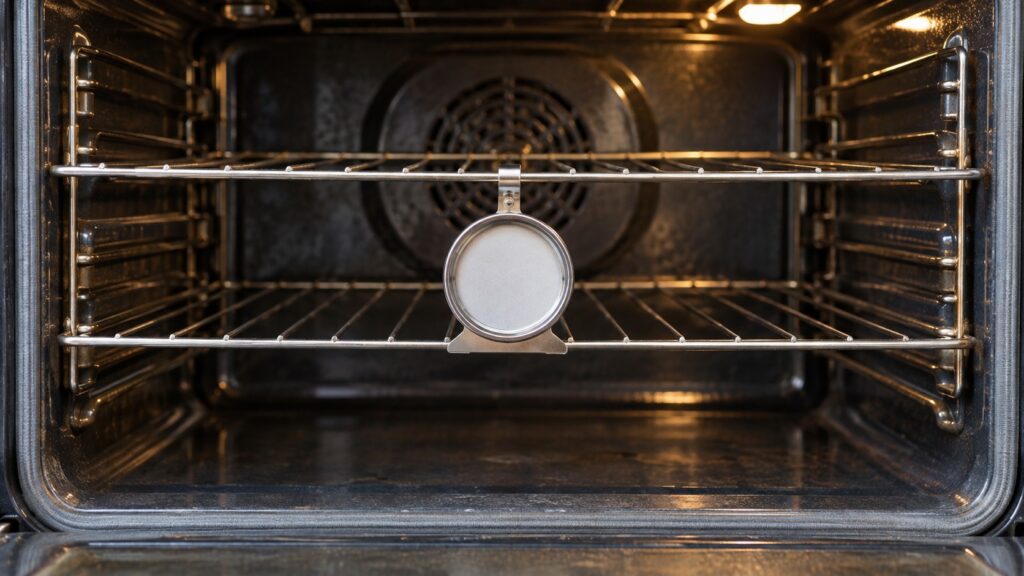
The oven’s display shows what the control believes, and belief is exactly what is in question. Put a standalone oven thermometer in the center of the middle rack, preheat fully, then wait a further fifteen minutes before reading it. That extra wait matters — ovens announce they are preheated before the cavity mass has caught up, and baking into an oven that has just beeped is a genuine and very common cause of uneven results.
Take several readings over twenty minutes. Every oven cycles around its set point, so a swing of some degrees either side is normal. What is not normal is a steady offset, or a swing so wide that the food sees two different ovens.
Loading, which causes more of this than parts do
- One pan at a time in the center when you are testing. Two sheets side by side block the air path between them.
- Leave clearance — a couple of inches around each pan and away from the walls.
- Never line a rack with foil. It turns a rack into a solid shelf and creates a hot zone above and a cold one below.
- Dark pans brown faster than shiny ones, sometimes dramatically. Two different sheets bake differently in a perfect oven.
- Rotate once midway. Even a well-behaved oven is not perfectly uniform, and every professional kitchen rotates.
If the browning pattern changes when you change the pan or the position, the oven is not the problem.
Convection is not a fault
A convection fan moves air, which strips the insulating layer against the food’s surface and speeds everything up. Recipes written for conventional baking will brown faster and cook sooner, and the usual guidance is to reduce the temperature or shorten the time.
On dual convection designs the airflow pattern is deliberate, and results are genuinely more even across multiple racks than a single-fan oven manages. Our dual convection guide covers how that works and what to expect from it.
The case worth investigating is a convection setting that does nothing — no audible fan, no difference in results. That points at the fan or its motor rather than at the recipe.
The door, and the check that takes thirty seconds
Close the door on a banknote and pull it, at several points around the edge. If it slides out freely anywhere, the seal has failed there. That is not subtle in its effect: heat escapes at that point, the cavity runs cooler on that side, and everything you bake reflects it.
Look at the gasket for flattened or hardened sections and at the hinges for sag — a door that no longer closes square puts uneven pressure on the gasket and wears it further. Our door and hinge care guide covers what is recoverable.
Calibration against a real fault
If the thermometer shows a consistent offset — the oven is always a certain amount below or above the set point, steadily — that is a calibration matter, and most ovens allow an adjustment. A consistent offset is a well-behaved oven reading slightly wrong.
A wide or erratic swing is different. That suggests the temperature sensor is drifting, and a drifting sensor produces exactly the pattern people describe as “sometimes it burns, sometimes it is raw”. The sensor is a resistance device and it changes value as it ages; the control acts faithfully on what it reads.
Our oven sensor guide covers the codes associated with that circuit, and the sensor glossary entry explains what the part actually is.
When it is an element
An electric element can fail partially rather than completely, and a partly failed element still glows in places. The signature is browning concentrated at one part of the cavity, consistently, regardless of pan or position.
On a gas oven, the equivalent is a burner with blocked ports firing unevenly along its length, or a weakening igniter producing a long delay before the burner lights — which means the cavity is cold for longer than the control believes. Our gas igniter guide covers that symptom.
Visual inspection helps here. With the oven cold and the power off, look at the elements for blistering, discoloration or a break. A visibly damaged element explains itself.
A short test that separates most cases
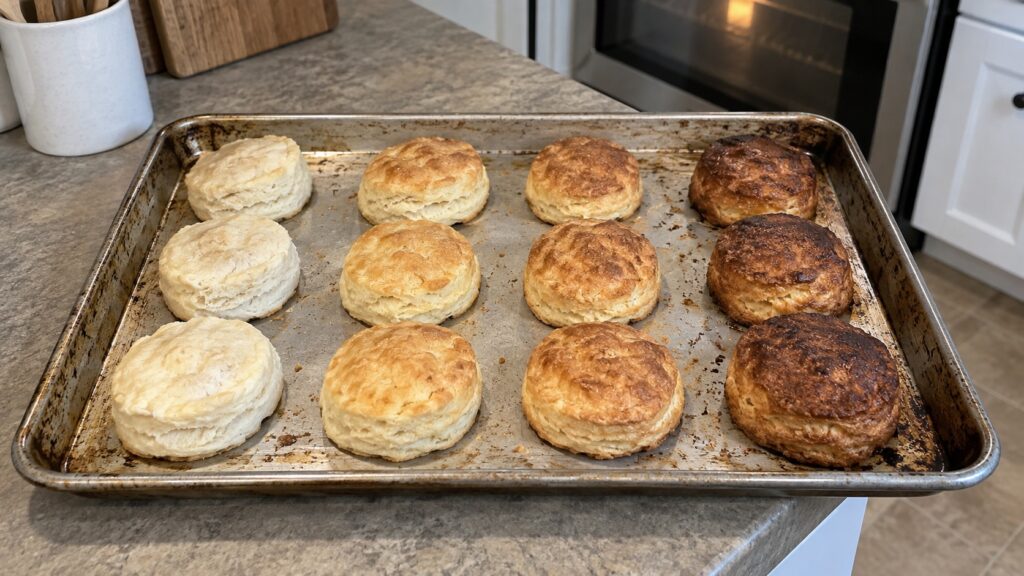
Bake a single sheet of plain scones or biscuits, evenly spaced, in the center of the middle rack, and do not open the door. Then look at the pattern. Even browning means the oven is fine and the problem is in how you have been loading it. Browning heavy at the back or one side points at airflow, a seal or an element. Pale everywhere with a long bake points at temperature. Burnt bases with pale tops points at rack position or a pan choice.
It is twenty minutes and a cheap ingredient, and it turns an argument into an observation.
When to call
Call when the measured temperature swings widely, when browning is consistently concentrated in one area regardless of loading, when a convection fan does not run, when the door will not seal, or when the oven displays a fault code.
We are an independent repair company and not a factory service arm. Pricing starts from a diagnostic visit and we confirm the estimate before any work begins. Wolf oven repair covers elements, sensors, fans, doors and controls, and you can schedule a visit online.