An oven door is a heavy, hot, precisely aligned assembly that gets pulled a few thousand times a year, and nobody maintains it until it stops closing properly. Twenty minutes a year on the wolf oven door hinge and gasket prevents the two failures that follow — uneven baking from a door that no longer seals, and a door that sags until it will not latch at all.
The banknote test, and what it tells you
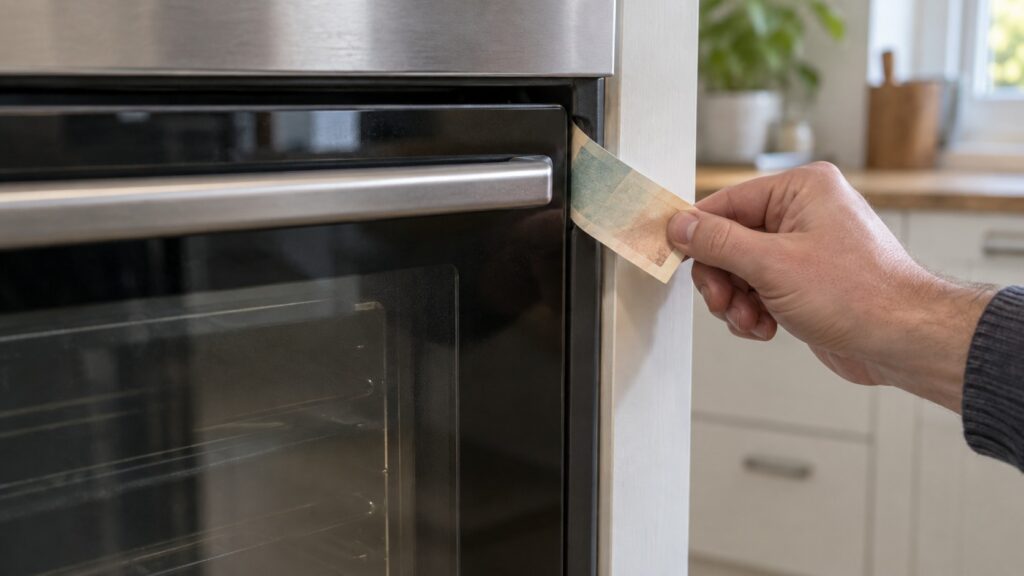
Close the door on a banknote so half of it is inside, then pull. Repeat at several points along the top, both sides and the bottom. The note should grip everywhere with similar resistance.
Where it slides out freely, the seal has failed at that point. That is not a subtle problem: heat escapes there continuously, the cavity runs cooler on that side, and every bake reflects it. A door that fails the test along the top usually means hinges; one that fails at a corner usually means the gasket itself.
Do this twice a year and you will catch the failure while it is still a gasket rather than after it has become a pattern of ruined baking you have been working around for months.
Looking after the gasket
The gasket is usually a woven rope or a formed seal clipped into the door or the frame. It hardens with heat and time, flattens where the door presses hardest, and collects spillage that then holds it away from the surface.
- Clean it gently with a damp cloth and mild dish liquid. Nothing abrasive and nothing caustic.
- Do not soak it. Woven gaskets hold water and it works its way into the door.
- Check it is fully seated in its channel or clips all the way around. A section that has popped out looks fine and seals nothing.
- Look for flattening — a section noticeably thinner than the rest is a section that has stopped sealing.
- Look for gaps at the corners, which is where gaskets shrink first.
A gasket is a replaceable part and replacing one is far less work than living with uneven baking. Our uneven baking guide covers how a seal failure presents at the results end.
Hinges, and the habit that kills them
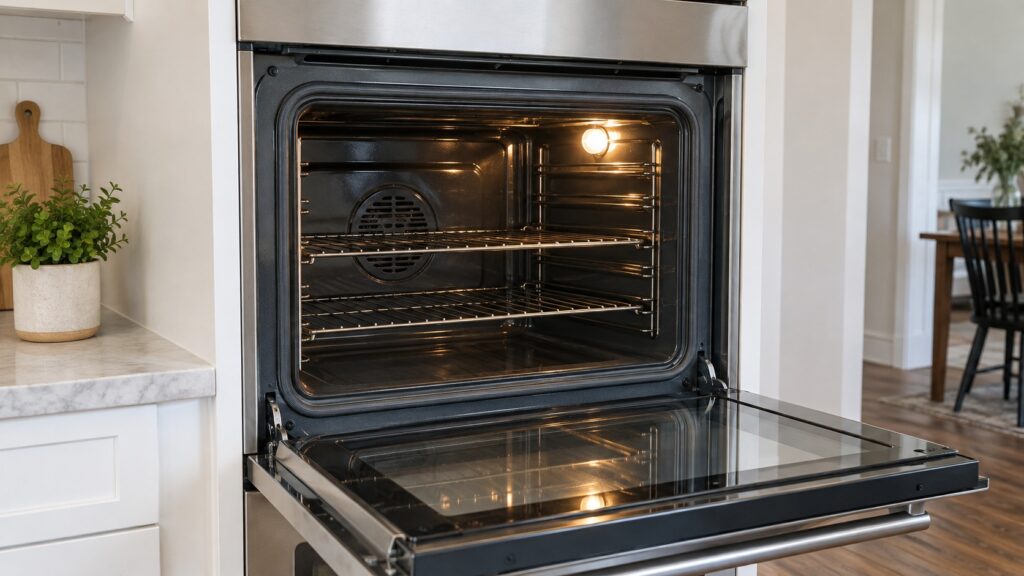
Oven doors hang on spring-loaded hinges carrying real weight, and they are designed for the door and nothing more. Leaning on an open door, resting a heavy roasting pan on it, or letting a child stand on it applies loads the hinge was never sized for.
The result is a door that sags — visibly lower at the handle end, no longer parallel with the frame, pressing hard on the gasket at the top and not at all at the bottom. Once a hinge is distorted it does not recover.
Check alignment by eye once a year: stand square to the appliance and look at the gap between the door and the frame along the top and both sides. It should be even. Then open the door slowly and watch for a hinge that binds, jumps, or lets the door drop the last few inches.
Cleaning around the door without damaging it
Clean the frame the gasket meets as carefully as the gasket itself, because baked residue on the frame holds the door off the seal just as effectively as a bad gasket does.
For the inner glass, a baking soda paste left to work for a while, then a plastic scraper at a shallow angle. Never steel wool, which scratches, and never cold water on hot glass, which can crack it. Avoid spraying cleaner directly at the door, because it runs into the vents and toward the controls.
And avoid using the self-clean cycle as a routine solution for a greasy door. That cycle runs the cavity far hotter than cooking does, and it is hard on the door lock, the gasket, the thermostat and the control. Our self-clean guide covers doing it with the least risk.
The lock, and why it matters year-round
The door lock is used by the self-clean cycle and is checked by the control at other times. A lock that no longer operates cleanly, or a switch that no longer reports its position, produces a fault that looks like a control problem and is not.
With the oven cool, watch and listen as a clean cycle begins — the lock should drive fully and audibly. If it hesitates or the appliance reports a door fault on a door that is plainly closed, that is the mechanism rather than the door. Our door lock fault guide and the door lock glossary entry cover what the part does.
Small habits that add years
Close the door rather than letting it swing shut, because the impact goes into the hinges and the glass. Do not hang towels over the handle, which applies a constant outward load. Lift heavy items onto a pulled-out rack rather than resting them on the door on the way in.
And keep the door closed while the oven is hot rather than leaving it ajar to vent — the hinge springs are at their weakest hot, and a door left open at temperature is exactly when a sag begins.
When to call
Call when the gasket needs replacing, when the door is visibly out of alignment or sags, when the hinges bind or the door drops, when the door will not latch, when the glass is chipped or cracked, or when the appliance reports a door fault on a door that is closed.
We are an independent repair company and not a factory service arm. Pricing starts from a diagnostic visit and we confirm the estimate before any work begins. Wolf oven repair covers doors, hinges, gaskets, locks and controls, and you can schedule a visit online.