A Wolf induction cooktop not heating properly, with no error code on the display, is usually caused by the cookware, by power being shared or limited, by the cooktop protecting itself from heat, or, less often, by a weak electrical supply. The pan is the first suspect because induction only heats a magnetic, flat-bottomed pan that sits properly on the zone. Work through the checks in order and you will find the cause or at least narrow it down for a technician before anything inside the cooktop is touched.
Is the cookware the reason it heats poorly?
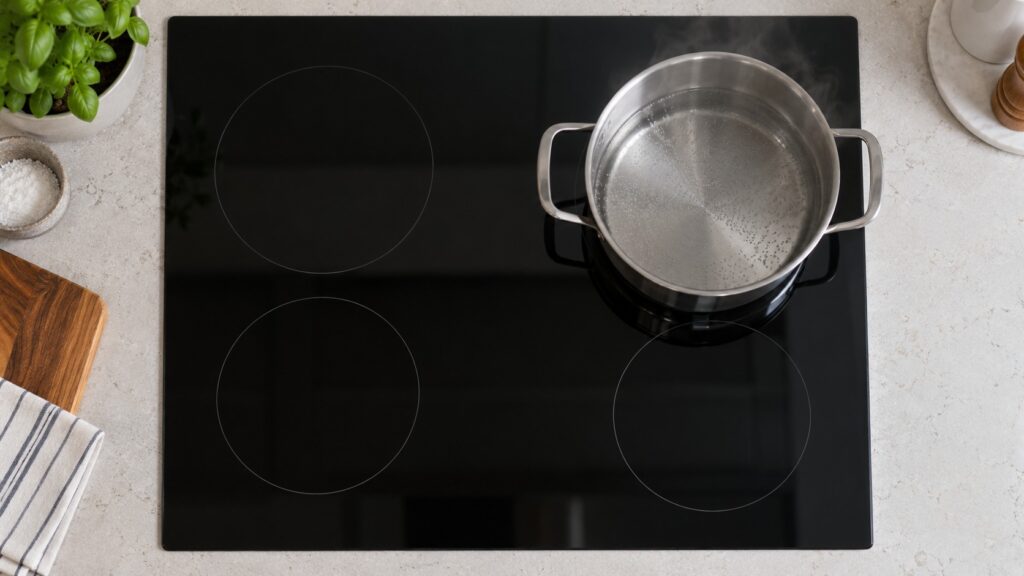
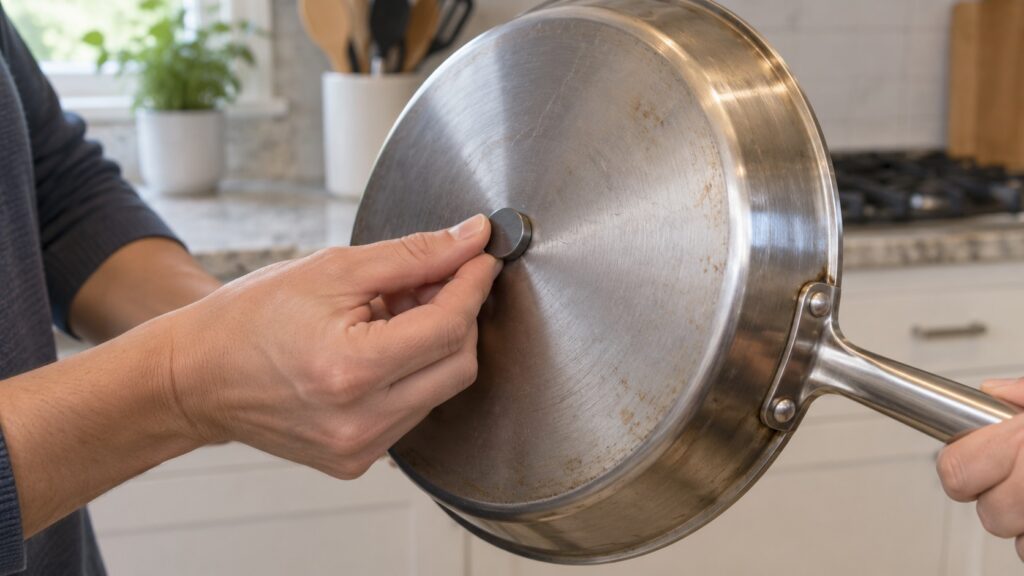
Check the pan before anything else. Induction heats the pan itself through a magnetic field, so the pan has to be magnetic and sit flat. Hold a refrigerator magnet to the bottom of the pan: if it clings firmly, the pan is suitable, and if it clings weakly or not at all, the pan will heat poorly or not at all. Aluminum, copper and some stainless steel pans do not work unless they have a magnetic layer in the base.
Shape matters too. A warped base lifts away from the glass and heats unevenly, and a pan much smaller than the zone may heat weakly, since the zone cannot couple with it properly. Try a different heavy, flat, magnetic pan on the same zone. If the new pan heats well, the cooktop is fine and the old pan was the problem. Our guide to Wolf induction cookware tips explains how to match pan and zone.
Could power sharing be limiting the zone?
On many induction cooktops, zones are grouped so that the power available to the group is shared. When two zones in a group run at high settings, each gets less than it would alone, and the cooktop reduces the power on one of them. That can look like a fault, because a pan that boiled water briskly a minute ago now simmers weakly after you started a second pan beside it.
Test it by turning every other zone off and running the suspect zone alone at the same setting. If it heats strongly again, the behavior is power sharing and not damage. Check your manual for how your model groups its zones and plan big, fast jobs for the zone with the most power available. For a plain explanation of the technology, see our guide to how Wolf induction cooktops work.
Is the cooktop protecting itself from heat?
Induction electronics produce heat of their own, and a cooling fan moves it away. If the airflow is blocked, if the fan is struggling, or if the cooktop sits above a very hot oven that was running a long self-clean, the electronics can reduce the power to protect themselves. The usual signs are a cooktop that starts strong and fades after a long cook, or one that is fine in the morning and weak at the end of a big dinner.
Listen for the fan once you turn the zones off; it often keeps running for a while to cool the electronics. If you never hear it, or it sounds rough, stop and have it checked. Our guide to the Wolf cooktop fan error E8 covers the fan family, and the page on heatsink faults explains what an overheating protection message looks like when one appears.
Could the electrical supply be weak?
An induction cooktop draws a large load from a 240-volt supply that is built from two lines. If one of the two is missing, for example because one half of a double breaker tripped, a loose terminal at the junction box, or a failed connection somewhere upstream, the cooktop may power on, display normally and still deliver only a fraction of its normal heat. Every zone feels weak, not just one.
Look at the breaker first. A double-pole breaker should be fully on, and a breaker that feels loose or has a scorch mark needs an electrician. Do not open the junction box or the cooktop yourself. Our guide to Wolf IR range electrical requirements shows how large and specific the circuit should be, and a licensed electrician can test it.
What if only one zone is weak and the pan is fine?
Then the cause is probably inside the cooktop: the coil under that zone or the electronics that drive it. Try the same pan on another zone to confirm that the pan and the supply are fine, and note whether the weak zone ever heats normally. A zone that works one day and not the next, or one that is fine cold and weak when warm, points at an electronic component warming up and failing.
Do not use a cooktop with a cracked or chipped glass surface, since liquid can reach the electronics underneath. If a code does appear, our guide to Wolf CT cooktop error codes lists the family, and a pan that is not recognized at all is a different symptom covered in pan not detected E6.
What should you do before you call?
Run the three quick tests: a different magnetic pan, the suspect zone alone, and a look at the breaker. Write down which zones are weak, whether it is worse when others are on, and whether it gets worse over time. Then Wolf cooktop repair explains what a visit includes, and the notes you took let the technician arrive with the right parts.