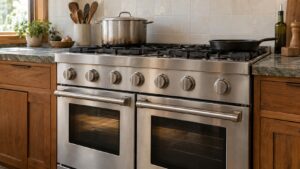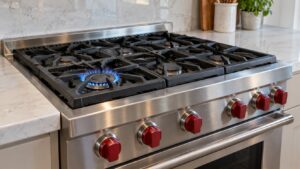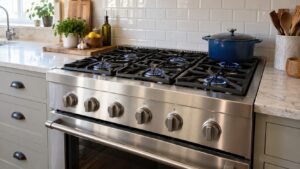
Two gas ranges can look nearly identical from the front and cook differently, clean differently and fail differently, and the reason is usually the burner construction. The wolf sealed vs open burners distinction is the most consequential piece of vocabulary in a professional-style kitchen, and it is rarely explained properly before purchase.
What “sealed” actually means
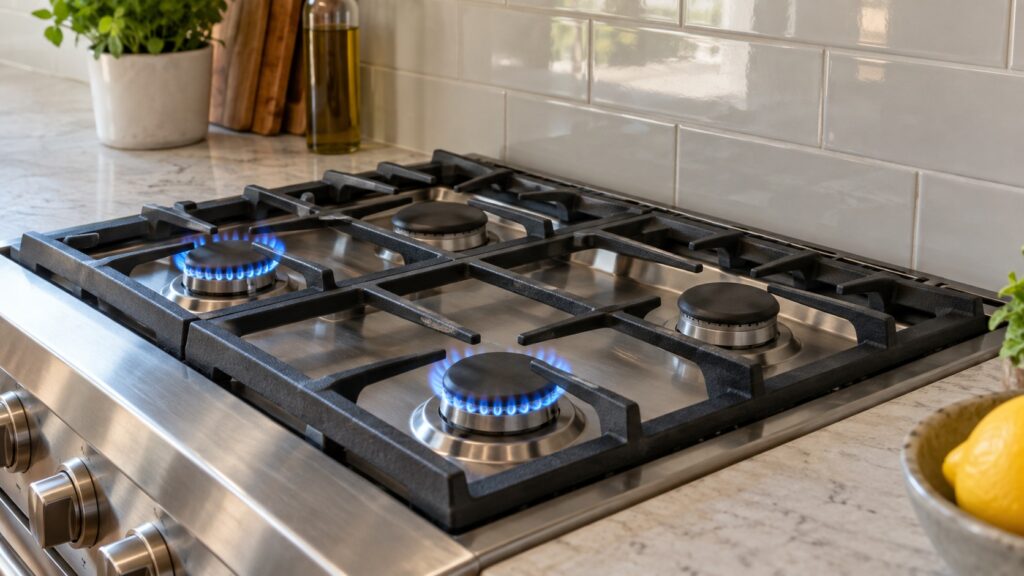
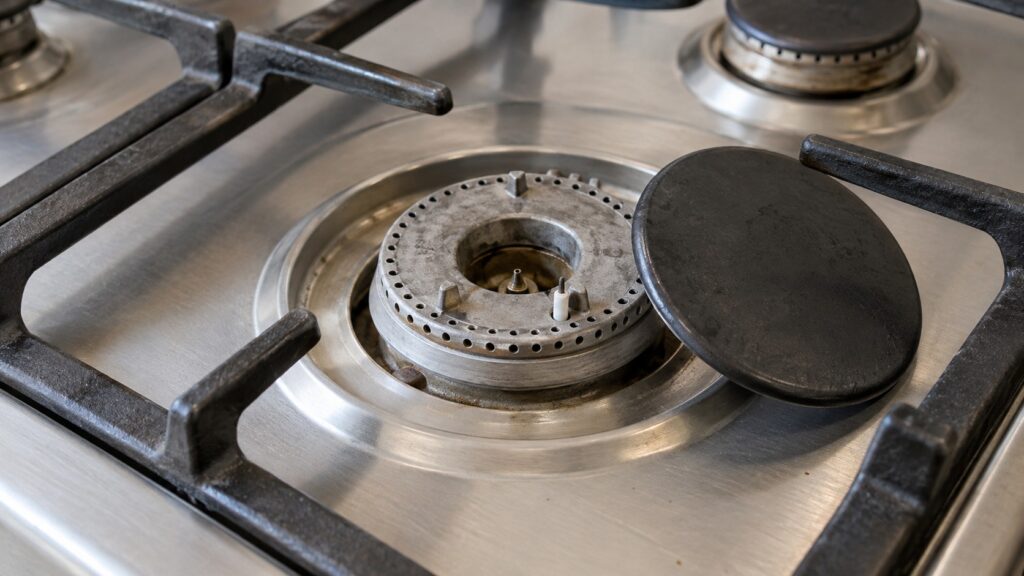
On a sealed burner cooktop, each burner base is joined to the cooktop surface so there is no opening around it. Liquid that boils over runs across the surface and stops there, and cleaning is a matter of lifting the grate and the burner cap and wiping.
That is the whole appeal, and it is a substantial one for anyone who cooks regularly. It also means the burner’s air supply comes through designed openings rather than from an open well, which is why sealed burners are engineered around a specific airflow.
The dual stacked arrangement takes this further, with two rings of flame at different levels so the burner can hold a genuine low simmer as well as a hard boil. Our dual stacked burner guide covers how that works.
What “open” gives you
An open burner sits above a well, and the burner draws combustion air freely from around and below it. Spills fall through into a removable tray.
The practical consequences run both ways. Free air supply supports high output, and open burner ranges are associated with the kind of raw heat a restaurant line uses. Grates tend to be heavy and continuous across the top, so pans slide rather than being lifted. And cleaning is a real job: the trays come out, and the well beneath gets attention.
It is worth being honest about that last point, because it is the thing people underestimate. An open burner range in a busy household needs cleaning as a routine rather than as an occasional event.
Terms that travel with this
- Rangetop — a cooktop with professional-style burners and no oven beneath, dropped into a counter.
- Range — the same cooking surface with an oven below it, as one appliance.
- Burner cap and head — the two-part top of a sealed burner. Misaligned, the burner will not light evenly.
- Simmer plate — a diffuser used on high-output burners to get a very gentle heat.
- Igniter or electrode — the spark source beside each burner.
- Spark module — one component driving every electrode, which is why a failure kills them all at once.
Our rangetop glossary entry covers the first two in more detail.
How they fail differently
Sealed burners fail mostly at the surface. Ports blocked by spilled food make one section of the ring light while the rest does not. A cap sitting slightly off center prevents lighting entirely or produces an uneven flame. Both are cleaning matters rather than parts.
Open burners add the well and the trays to the list. Debris in the well affects the air supply, and a burner starved of air burns yellow and sooty rather than blue. On both types, a cracked electrode insulator sends the spark to ground instead of across the gap, which reads as a burner that clicks and never lights.
Our burner will not ignite guide and the continuous clicking guide cover the two commonest symptoms.
Reading a flame
A correctly adjusted gas flame is blue, steady, and sits on the burner without lifting away from it. Three deviations are worth knowing.
Yellow or orange tips with soot mean the air supply is wrong — blocked ports, debris, or an appliance set up for the wrong fuel. A flame that lifts off the burner and roars means too much gas or too much air. And a flame that will not go low, or goes out when set low, points at the valve rather than the burner.
Orange flashes without soot are usually harmless: dust or salt burning off, common after cleaning or in a dusty room. A humidifier running nearby produces the same effect, because minerals in the mist burn as the air passes through the flame.
Propane against natural gas
These appliances are built for one fuel and converted for the other with a kit that changes the orifices, because the two fuels need different gas flow. Running an unconverted appliance on the wrong fuel produces either a tiny useless flame or a large sooty one, and it is not safe.
If an appliance has moved house, or the property has changed fuel supply, confirm the conversion was done. It is a common oversight and it shows itself as a range that has never cooked properly since it was installed.
Grates, and the part people forget to ask about
Grates do more than hold pans. Continuous grates let you slide a heavy pot from one burner to another without lifting it, which matters more in daily use than any specification on the box. Individual grates are easier to lift out and wash but make a discontinuous surface.
Weight matters too. Heavy cast iron holds position and does not skate when you push a pan, and it also survives a decade of thermal cycling without warping. The trade is that it is heavy to remove for cleaning, and porcelain-coated grates chip if they are dropped.
Choosing between them
Choose sealed if cleaning matters to you, if the kitchen is used daily by people who are not all equally careful, and if a genuine simmer is as important as maximum output. Choose open if raw output and a continuous grate surface matter most and you accept the cleaning routine.
Our range buying guide and the gas against dual fuel guide cover the other axes of the same decision.
When to call
Call for any gas smell — shut the supply off first. Call when a burner will not light with a clean cap and head, when flames are yellow and sooty, when no burner sparks at all, when a burner will not hold a low flame, or when an appliance needs a fuel conversion.
We are an independent repair company and not a factory service arm. Pricing starts from a diagnostic visit and we confirm the estimate before any work begins. Wolf range repair covers burners, igniters, valves and controls, and you can schedule a visit online.