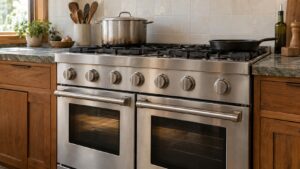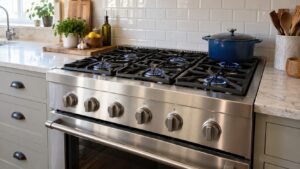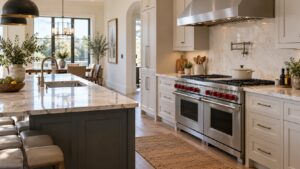
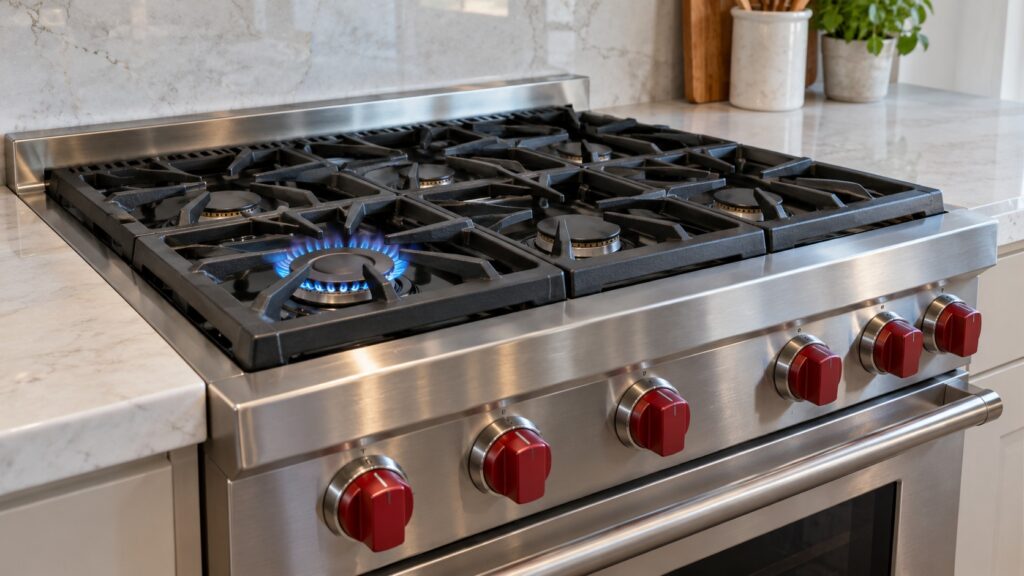
How Wolf spark ignition works comes down to one idea: when you turn a knob, a small electric spark jumps near the burner and lights the gas, and the clicking you hear is that spark repeating until the burner reports a flame. On the Wolf gas rangetop pages on our site, every burner is lit by an electric spark igniter and every burner shares one spark module, which is why one wet or blocked igniter can make the whole surface click at once. What a given step looks like on your exact range or rangetop is set by the model, so treat the owner’s manual as the final word.
How does a Wolf gas burner light when you turn the knob?
Turning a Wolf burner knob does two jobs together. It lets gas flow toward that burner, and it tells the spark module to start firing at the igniter beside the burner. Gas reaches the burner head, meets the spark, and lights. That is the same basic idea as any electric-spark gas burner, and it is why you hear a quick run of clicks before the flame appears.
The Wolf rangetop pages on our site describe dual-stacked sealed burners with a true simmer on the lower ring, mechanical knobs and spark ignition with all burners on one module. Liquid that gets into an igniter well, for example after cleaning or a boil-over, can stop a spark from reaching the gas. Our dual-stacked sealed burners guide covers the burner design itself.
Why does the clicking keep going after the burner is lit?
The spark module keeps firing until each burner confirms a flame. Our rangetop clicking page explains that on an SRT every burner shares one module, so if one burner cannot confirm a flame, the clicking carries on for the whole surface, even when the other burners are burning steadily. That is why people search for terms like “Wolf range keeps clicking” or “Wolf range won’t spark”: it is usually one burner out of the group that is holding up the clicking, not the whole range.
The causes our pages list are the everyday ones: moisture in an igniter well after cleaning, a burner cap that is tilted or not fully seated, an oversized pan sitting over the igniter gap, and, less often, reversed polarity at the wall outlet, which an electrician should confirm. Our Wolf rangetop continuous clicking guide takes those in order.
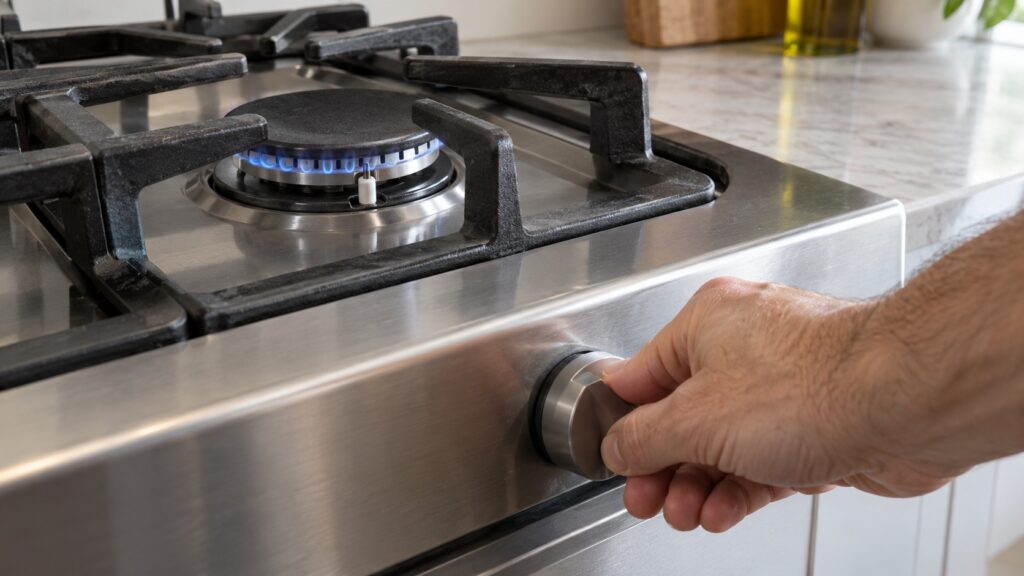
What can you safely check when a burner will not spark?
Everything below is done with the burners off and cool, and none of it involves opening the range or touching gas fittings.
- Lift the cap and head off the burner and set them back so they sit flat and square. One tilted cap can make every burner click.
- After cleaning or a spill, let the burners dry. Our pages give 24 to 48 hours for a wet igniter well to dry out.
- Move any oversized pan off the igniter gap and try again with a smaller pot.
- If the whole surface will not spark at all, check that the range has power. A tripped breaker takes the spark with it.
If a burner still clicks with a seated cap, dry well and the right pan, stop there. The remaining causes are the igniter itself, the shared module or the outlet, and those are for a technician. Our rangetop burner won’t ignite guide and the gas cooktop won’t light guide separate no-spark from spark-but-no-flame.
How is the oven igniter on a gas range different?
The oven on an all-gas Wolf GR range lights in a different way from the surface burners. Our gas oven igniter page describes a glowing oven igniter that must reach a particular temperature to draw enough current to open the safety gas valve. As it ages it can still glow but no longer get hot enough, so the valve stays shut and the oven never lights. There is no error code on a gas oven, so the symptom is what you diagnose: glows but no flame, a long delay and then a puff of flame, or no glow at all.
It is easy to mix the two systems up. Surface burners click and spark; the oven igniter glows. Replacing the oven igniter involves the gas valve circuit and is a technician job. Dual fuel (DF) and induction (IR) ranges have electric ovens instead, so this oven igniter does not apply to them. Our gas oven igniter failure guide goes through the signs.
When is clicking or no spark a safety problem?
Keep the rule simple. If you smell gas, do not turn anything on or off, do not light anything and do not use a phone or light switch inside. Leave the house and call your gas utility or 911 from outside. A burner that clicks but will not light is not itself an emergency, but do not keep turning the knob to force it: turn it off and air the room. If you notice any smell of gas, do not try that burner again and follow the rule above. Never use a match or lighter at a sealed burner, because gas can collect before it lights. Anything beyond the cap, dry-out and pan checks above is a job for a technician, not for repeated attempts.
Gas lines, valves and regulators are specialist work. Please do not take apart the burner base, the igniter or the spark module yourself, and do not adjust the gas supply. If water has reached the outlet or you see sparks or smell burning, switch off the breaker at the panel while standing on a dry floor, and do not pull a plug out of a wet outlet.
What should you tell a technician about the spark?
A clear description saves a visit. Say whether it is the rangetop or the oven, whether one burner or all of them click, whether it started after cleaning or after a new pan, and whether the clicking stops when the burner lights. Include the full model number from the rating plate; our GR366 page shows what a model page lists. For a rangetop or range, our range repair page explains what a visit covers, and you can book a visit online.