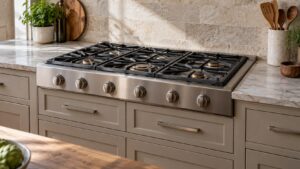
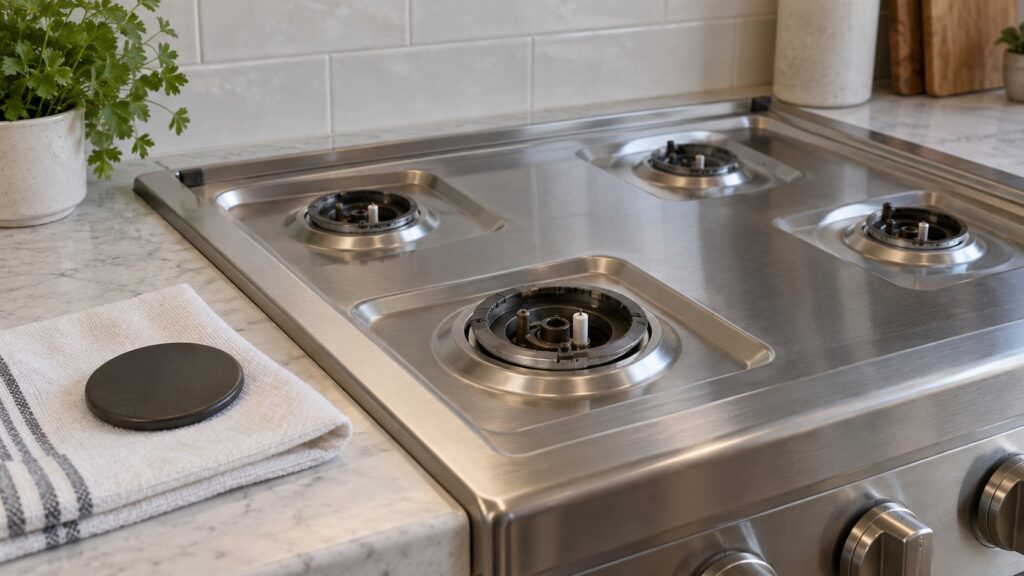
Wolf burner cap and igniter cleaning is a short routine: let the rangetop cool completely, lift off the grates and caps, wash the caps in warm soapy water, clear the burner ports with a soft brush or a wooden toothpick, wipe the igniter tip with a damp cotton swab, and let every part dry fully before you set the caps back in place. Done every few weeks, it takes about ten minutes and prevents the two problems we hear about most from sealed-burner owners: a burner that keeps clicking and a flame that is uneven or will not light.
Why do Wolf burner caps and igniters need regular cleaning?
A sealed gas burner works only when gas leaves through clean ports in a pattern the flame can hold, and the spark from the igniter arrives at the right spot. Boiled-over sauce, grease mist and mineral deposits quietly change both. Residue on the cap changes the way flame spreads. A blocked port starves part of the ring. A film on the igniter electrode weakens the spark, and a wet or sticky igniter can click repeatedly because it keeps trying to light a burner that is not delivering a clean fuel-and-air mix. None of this is a sign that the range is failing; it is a sign that the burner needs attention.
Wolf’s sealed layout is easy to look after because spills stay on top of the sealed tray rather than dropping into the cabinet, but easy does not mean maintenance free. Our glossary entry on sealed and open burners explains why the design behaves this way, and the dual-stacked sealed burners entry covers the two-tier ring that needs a little extra care.
How do you clean a Wolf burner cap safely?
Make sure every burner is off and the surface is cool to the touch. Lift the grates away first, then lift each cap straight off its base. Soak the caps for a few minutes in warm water with a mild dish soap, then scrub with a soft brush or a non-scratch sponge. Rinse and dry them thoroughly, because water trapped in the cap or the seat will keep the flame from lighting cleanly. Check your manual for what finish your caps have, since some finishes should not meet harsh cleaners or abrasive pads. If a spill has baked on, a longer soak is safer than scraping.
Do not put caps back while they are damp. A wet cap on a hot burner can steam, spit and leave marks, and moisture in the seat is a common cause of a burner that sputters for the first minute. Set the clean caps on a towel and let them air dry while you clean the grates and the surface.
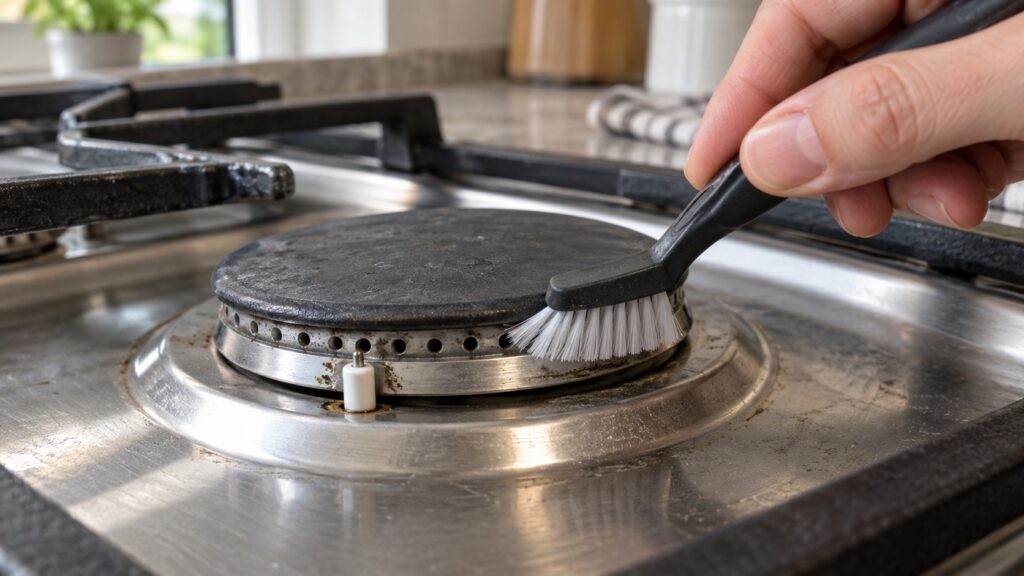
How do you clear the burner ports without damaging them?
Ports are small, and the instinct is to jab something into them. Resist it. A soft brush or a wooden toothpick is enough to loosen carbon and food from a port; a metal pin or needle can widen the hole, and a widened port changes the flame for good. Brush from the outside in, tap out loose debris, and wipe the base with a damp cloth. Never spray cleaner into the ports or into the igniter well, because liquid left in a burner base can make it hard to light and can leave a residue that burns off with an unpleasant smell.
After brushing, look at the base in good light. Every port should be open and the ring should look evenly clean. If you can see a port that stays blocked after careful brushing, or a crack in a cap, stop using that burner and book service rather than forcing it.
How should you clean the igniter electrode?
The igniter is the small ceramic-and-metal tip beside each burner. With the gas control off and the burner cool, moisten a cotton swab with a little water or the cleaner your manual allows, and gently wipe the tip, removing any film or crust. Do not scrape it, bend it or press hard, since the ceramic insulator can crack. Dry it with a clean swab. A clean, dry igniter tip should spark crisply and in the right place.
If a burner clicks without stopping, residue on the igniter is the first thing to rule out, and the second is moisture in the base. Our guide to Wolf rangetop continuous clicking goes through the causes in order, and the symptom page for rangetop continuous clicking is the quick lookup.
What if cleaning does not fix the problem?
Cleaning solves a surprising share of lighting problems, but not all. If a burner still clicks, lights late, burns yellow or tips, or goes out when you lower the flame, the cause may be a worn igniter, a failing spark module or a gas-side issue, and those are not safe to chase with a screwdriver. Read our rangetop burner will not ignite diagnosis for the order in which a technician looks at them, and the wider Wolf rangetop maintenance guide for the rest of the routine.
If you smell gas at any point, leave the house and call your gas utility from outside. Do not try to clean or relight anything.