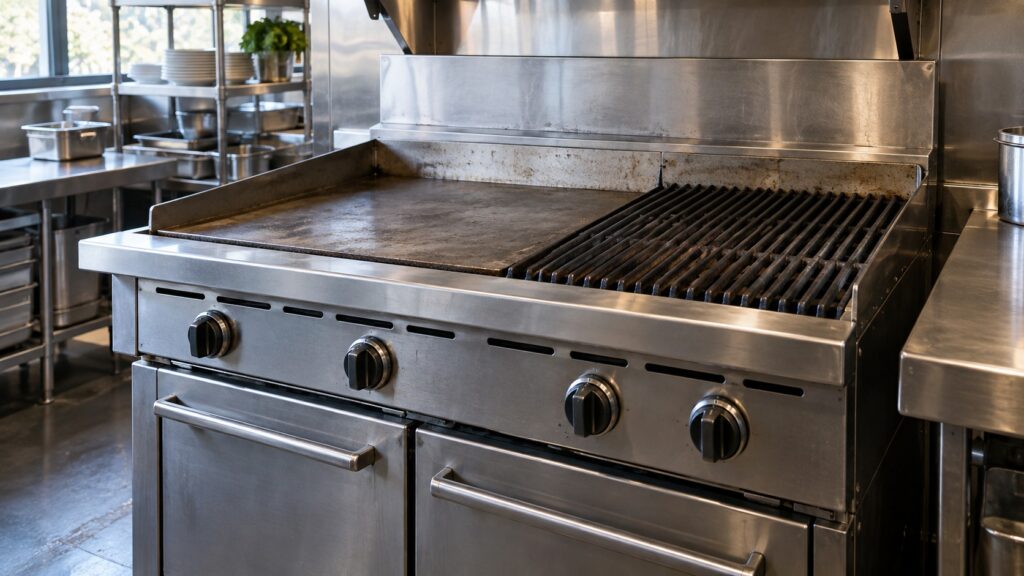
The griddle and charbroiler modules are the parts of a professional rangetop people use least and enjoy most once they understand them. A wolf charbroiler griddle setup is not a frying pan built into the counter — each has a specific way it wants to be heated, loaded and cleaned, and treating them like burners is why so many end up as expensive shelf space.
Preheat is the whole technique
A griddle plate is a substantial piece of metal, and it takes a long time to reach an even temperature throughout. Cook on it after two minutes and you get a hot patch over the burner and cool metal everywhere else, which is why people report griddles that cook unevenly when the appliance is working perfectly.
Give it ten to fifteen minutes on a medium setting. A drop of water is the classic test: it should skitter across the surface rather than sitting and boiling. Once it is evenly hot you can cook at a much lower setting than you expect, because the mass holds heat and returns it to the food.
A charbroiler needs the same patience for a different reason — the grates and the radiants have to come up to temperature or food sticks and never marks properly.
Seasoning and caring for a griddle
A griddle plate works best with a thin polymerized layer of oil on it, the same principle as a cast iron pan. It is not a coating you apply once; it builds with use and it is maintained rather than created.
- After cleaning, wipe a very thin film of a high smoke point oil across the warm plate and let it heat until it stops smoking.
- Thin is essential. Excess oil polymerizes into a sticky, patchy varnish that is worse than bare metal.
- Do not use soap on a seasoned plate beyond what is needed, and never a wire brush that strips it.
- Cook fatty things on it — bacon and burgers maintain the surface better than anything you do deliberately.
Some plates are chrome or non-stick finished rather than bare steel, and those are not seasoned at all — check which yours is before oiling it, because the care is different.
Cleaning the griddle without warping it
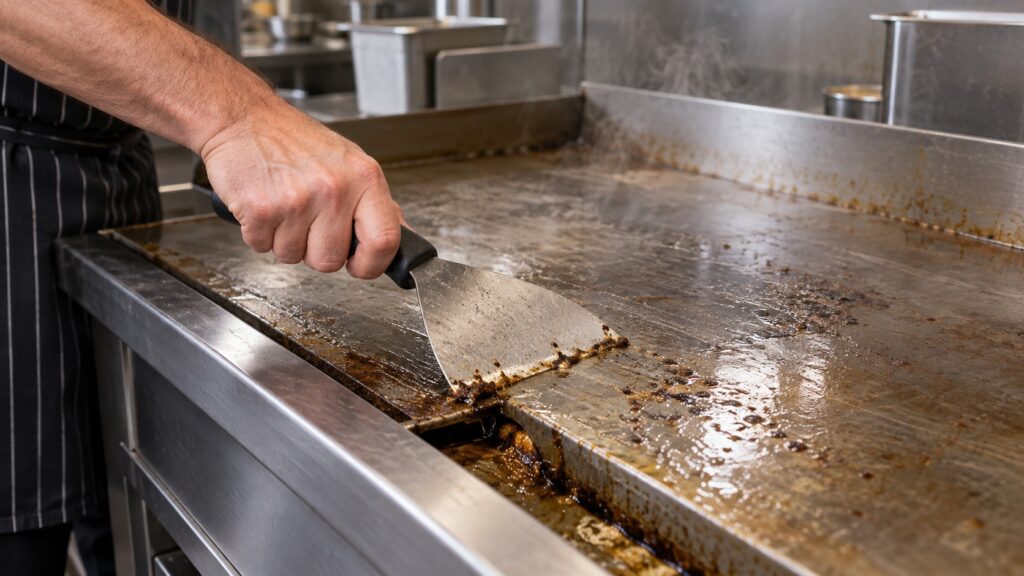
Clean it hot, immediately after cooking. Scrape the residue to the drip channel with a griddle scraper held flat, then pour a small amount of water onto the hot surface to lift what remains — the steam does the work. Scrape again, wipe with a cloth on a long handle, and re-oil.
The rule that matters: never dump cold water onto a hot plate. Thermal shock warps the plate, and a warped griddle will never cook evenly again and cannot be straightened. Small amounts of water for deglazing are fine; a jug of cold water is not.
Empty the drip tray every time. It is the difference between a rangetop that smells good and one that does not.
Using the charbroiler well
A charbroiler cooks by radiant heat, and the marks come from contact with hot grates. Two habits produce most of the difference between good results and disappointment.
First, dry the food. A wet surface steams before it sears, and steam is the enemy of both marks and crust. Pat meat dry and let it sit uncovered in the refrigerator if you have the time.
Second, leave it alone. Food releases from a hot grate when a crust has formed; moving it early tears it and leaves protein on the grates. If it sticks, it is not ready.
Flare-ups are part of the mechanism rather than a fault — fat drips, ignites and adds flavor. Manage them by moving food rather than by spraying water, which creates steam and ash and does nothing useful.
Zone your heat if the module allows it. Running one section hot for searing and another lower for finishing is how a restaurant line works, and it removes the choice between a burnt crust and a raw center on anything thicker than a steak.
Ventilation, which is not optional here
These modules produce far more smoke and grease aerosol than any burner, and they produce it continuously rather than in bursts. Run the hood from before you start until several minutes after you finish, so the duct clears rather than sitting full of greasy air.
They also raise the case for makeup air, because sustained high hood speed in a sealed house is where negative pressure problems appear. Our makeup air guide covers that, and the baffle filter guide covers keeping the filters doing their job.
Where things go wrong
A griddle that cooks unevenly after a full preheat, with no warping visible, points at the burner beneath it — blocked ports on one section, or a weak flame. A charbroiler that will not reach temperature points the same way.
A module that will not light at all is the same diagnosis as any other burner: cap and head seated, ports clear, electrode clean and dry, spark module working. Our rangetop ignition guide covers it, and the rangetop maintenance guide covers the routine for the whole surface.
When to call
Call for any gas smell. Call when a module will not light with everything clean and seated, when the flame is yellow and sooty, when a griddle cooks unevenly after a proper preheat, when a burner will not hold a low setting, or when a plate has warped.
We are an independent repair company and not a factory service arm. Pricing starts from a diagnostic visit and we confirm the estimate before any work begins. Wolf rangetop repair covers burners, igniters, valves and controls, and you can schedule a visit online.