A Wolf range PF error means the appliance lost power during a cycle, or the oven is too hot for the mode you asked for. It is an announcement, not a failure — the control is telling you it stopped because of something outside the range. Two related messages come from the same family: a brownout error on a Wolf E-Series wall oven means the voltage sagged rather than disappeared, and a fuses-wrong message means the control is configured for a different model than the one it is fitted to.
What does a Wolf range PF error actually mean?
PF stands for power failure. The range noticed that its supply was interrupted while a cycle was running, and rather than resuming blindly it stopped, held the message and waited for a person. This behavior is deliberate: a range that silently resumed a self-clean cycle after an outage would be a hazard, and an oven that came back to a set temperature with no one home would be worse.
The second meaning catches people out. On some Wolf controls the same message covers an oven that is too hot for the mode requested — most often when a self-clean or a high-temperature program is selected while the cavity is still hot from cooking. Nothing has failed. The oven needs to cool before it will accept the instruction.
Those two readings suggest two different first moves. If the neighborhood lost power, or you heard the air conditioning drop out, the message is simply a record of that. If the message appeared on a calm day with no outage, look at what mode was being started and how hot the oven already was.
How do I clear PF and get the range running again?
In the order that finds the fault fastest:
- Acknowledge the message. Cancel or Off clears it on most controls. The clock will usually need setting, which itself confirms that power was interrupted.
- Let the oven cool if a high-temperature mode was refused. An hour with the door closed and the range off is normally enough.
- Start an ordinary bake. If the range preheats and holds temperature, the event has passed and nothing else is needed.
- If PF returns without any outage, cycle the breaker once. Off for two minutes, then on. A repeat immediately after that is no longer about the weather.
A Wolf range PF error that keeps coming back on its own is the case worth taking seriously, because it means the appliance is losing supply and you are not seeing it happen. That points at the circuit, not at the range.
What is the difference between PF and a brownout error?
PF is a supply that went away. A brownout error on a Wolf E-Series wall oven is a supply that stayed but sagged — the voltage fell far enough that the control could no longer trust it. The distinction matters because they have different causes and different fixes.
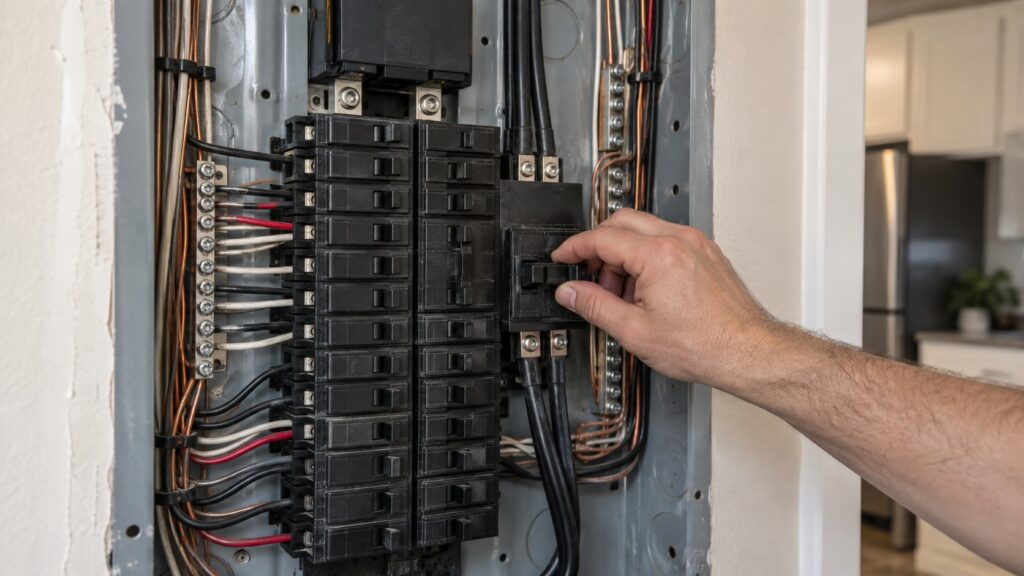
A range runs on a 240-volt supply made of two legs. If one leg is lost — a tripped half of a double-pole breaker, a loose lug, a failed connection at the panel — the appliance still sees 120 volts and still lights up. The control panel works, the clock runs, and the oven cannot heat properly. That state produces low-voltage complaints and strange half-working behavior far more often than it produces a dead appliance.
Sustained low voltage also shows up in three predictable situations: an undersized or shared circuit, a long run of wire to a remote kitchen, and any installation running on a generator or an inverter. A generator whose output sags under load will produce brownout messages on an appliance that behaves perfectly on utility power.
None of that is repaired inside the range. Voltage measured at the terminal block while the oven is heating is the test, and it is a test for a technician or an electrician with the appliance pulled out.
Why would a control say the fuses are wrong?
A fuses-wrong message means the controller configuration is incorrect: the control is set for a different model than the appliance it is installed in. Like the configuration codes on Wolf cooktops, it is a message that follows work rather than wear.
It turns up after a control board has been replaced and not configured, after a board has been moved between two similar appliances, or occasionally after an electrical event scrambled what was stored. The symptom that comes with it is usually something that looks like a wiring fault — elements that do not behave the way the panel says they should, or a double oven where one cavity acts like the other.
There is no homeowner procedure for this and no key sequence worth printing, because the correct value depends on width, fuel type and whether the appliance is a single or double configuration. What is useful from the kitchen is the history: if anyone has been inside the appliance in the last month, say so when you call. It turns an hour of diagnosis into a five-minute setting.
Which power problems damage a Wolf range?
Most do not. A clean outage is the least harmful thing that happens to an appliance — the control stops, the message appears, and nothing is stressed. The events that cause real damage are the messy ones: repeated dips, a lost neutral, a surge from utility work or a nearby strike.
The signs worth acting on are these. Codes that appeared for the first time immediately after an electrical event and never went away. A relay fault, which on a Wolf range shows as a communication error and is covered in our guide to the Wolf range communication error and stuck relay. A door lock that stopped responding after an outage, which you can read about in the E-Series oven F1 door lock error. Or a self-clean cycle that will no longer start at all, which has its own causes in our self-clean guide.
If a power event was followed by any of those, the outage did not cause a cosmetic complaint — it exposed or created a component fault, and the message you are seeing now is the second one, not the first.
What should I do before a service call?
Three things are safe, useful, and free. Check whether other 240-volt appliances in the house are behaving — a clothes dryer that has also gone strange moves the problem to the panel. Check whether both halves of the range breaker are in the same position, and reset the breaker fully off before on rather than nudging it. And note the sequence: what the display said, whether the clock had reset, and whether the oven could still preheat afterward.
Do not open the terminal block cover at the back of the range, and do not measure voltage at the appliance with it energized. That connection carries the full supply, and it is the one place where a mistake is not recoverable.
We are an independent repair company, not a factory service arm. Pricing starts from a diagnostic visit and we confirm the estimate before any work begins. If a Wolf range PF error keeps returning with no outage behind it, call (844) 991-2780 or schedule a visit, and our Wolf range repair service will start at the supply rather than at the board.