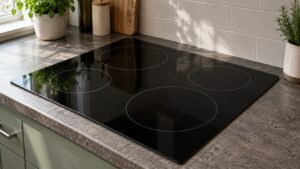
A downdraft vent does the opposite of everything a hood does. Rather than catching a rising plume above the cooktop, it pulls air sideways and down at the level of the pans. Understanding how the wolf downdraft vent works explains both why it is the right answer for an island cooktop and why it will never match a good overhead hood on a hard sear.
The mechanism
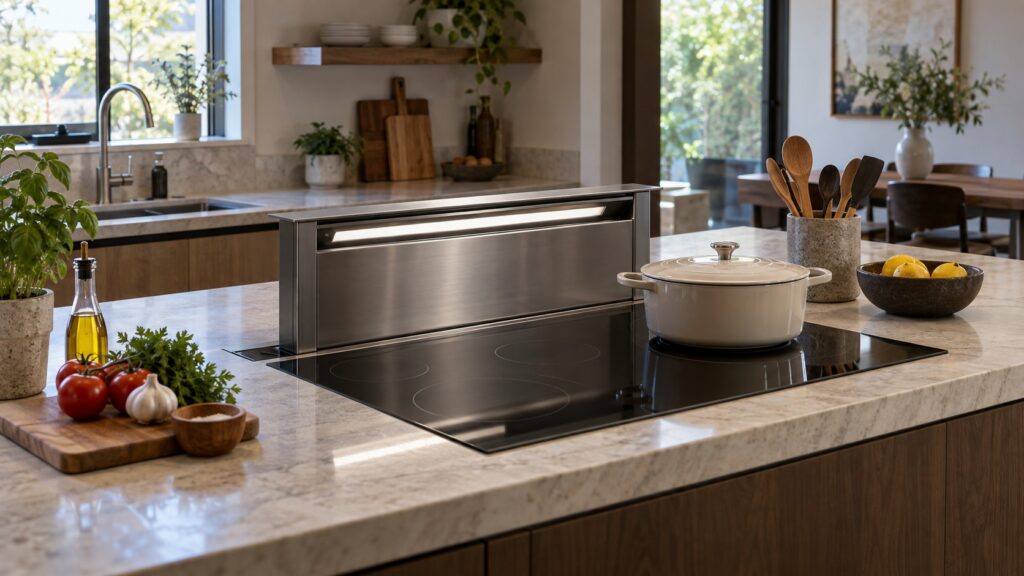
A motor raises a vertical panel from a slot behind the cooking surface — usually several inches above the counter. Air is drawn into a slot in that panel by a blower beneath the counter, passes through a grease filter, and is ducted away through the cabinet, usually down and then out through a wall or the floor.
When you switch it off, the panel lowers back into the counter and the cooktop returns to a flat, uninterrupted surface. That disappearing act is the entire point, and it is why downdrafts exist in kitchens where an island is the design centerpiece.
Why it is fighting physics
Hot air and steam rise. An overhead hood simply has to be in the way of that column, and a well-sized one captures most of it without effort.
A downdraft has to catch the plume sideways before it rises out of reach, which means it must move a great deal of air and must be close to the source. The further the pan is from the vent panel, and the taller the pan, the more of the plume escapes above the capture zone.
That is not a defect in any particular unit; it is the geometry of the arrangement. Knowing it changes how you cook rather than how you feel about the appliance.
Getting the most out of one
- Use the rear burners for anything that steams or spatters. Capture at the back is far better than at the front edge.
- Raise it before you start, not when smoke appears. Capture works on a plume it is already in.
- Use lower, wider pans where you can. A tall stockpot puts the plume above the panel.
- Lids are your friend. A lid on a simmering pot removes most of what the vent would otherwise have to catch.
- Run it a few minutes after cooking, so the duct clears rather than sitting full of greasy air.
Ducted or recirculating
A ducted downdraft carries air outside. A recirculating one passes it through a charcoal filter and returns it to the room, which is the fallback where a duct route does not exist — in an apartment, or an island over a slab.
The distinction matters more here than with an overhead hood, because a downdraft already has a harder job. Recirculating does something about grease and odor and nothing about heat and moisture, and its charcoal filter saturates rather than washes, so it must be replaced periodically. Our vented against recirculating guide covers the trade in detail.
The duct run, where performance is decided
Downdraft ducting is harder than hood ducting because it starts below the counter and often has to turn immediately. Rigid metal, sized to the unit’s requirement, with as few tight turns as the layout allows, terminating outdoors at a cap that opens freely.
An undersized or convoluted run is the most common reason a downdraft underperforms after installation. The blower is doing its rated work and the duct is not letting it. Our vent setup guide covers sizing and routing, and the principles apply to both arrangements.
Makeup air deserves a mention too. A downdraft moving serious airflow in a tightly built house runs into exactly the same negative-pressure problem an overhead hood does, and our makeup air guide covers it.
What lives under the counter
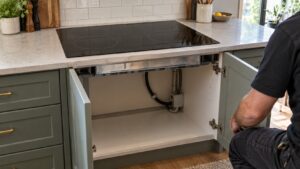
A downdraft is not only the panel you can see. Beneath the counter sit the blower, the lift mechanism and the first section of duct, and they occupy space in the cabinet that the cabinetmaker has to plan for.
That has two consequences worth knowing. A drawer directly beneath the cooktop is frequently not possible, or is reduced to a shallow one, and the cabinet loses usable depth. And service access matters: if the blower is walled in behind fixed panels, every future visit starts with carpentry.
If you are specifying a kitchen rather than living with one, ask how the unit will be reached before the cabinets are built. It costs nothing at that stage and it is expensive afterwards.
Maintenance, which is short but not optional
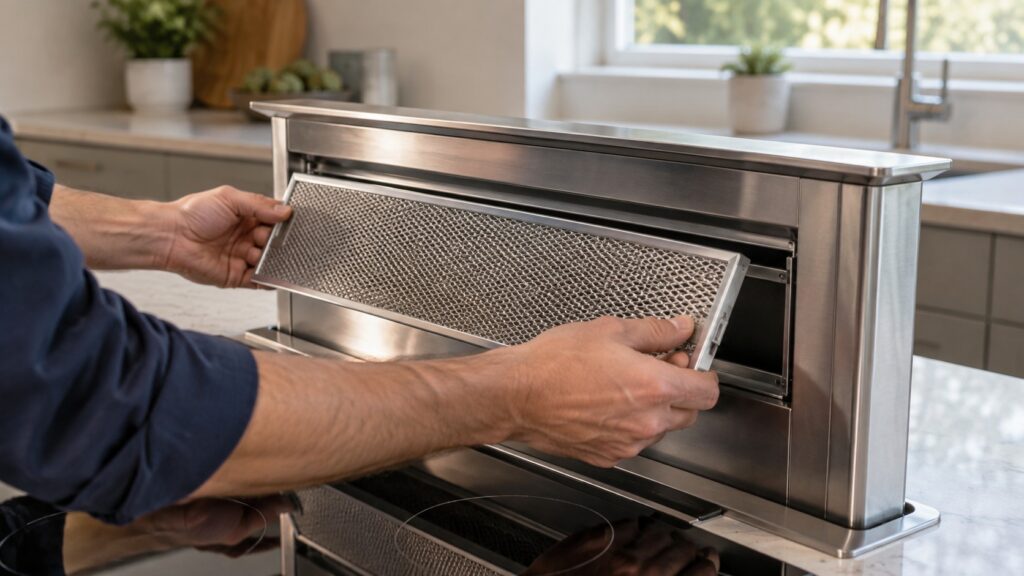
Grease filters slide out of the vent panel and want washing monthly with heavy cooking, quarterly otherwise — hot water, degreasing dish liquid, and a soak rather than a scrub.
Wipe the panel itself and the slot it retracts into. Grease and crumbs in that slot are the commonest cause of a panel that raises unevenly or sticks, and it is far easier to clean than to repair. Check the panel’s travel is smooth and that nothing on the counter obstructs it before you press the switch.
When it stops working properly
Separate the two halves of the appliance before deciding anything. A panel that will not raise or lower is a motor, a drive or an obstruction. A panel that raises normally while the blower moves no air is a blower, a duct or a filter problem.
That distinction makes the conversation far shorter, and it is something you can determine in ten seconds. Our will not raise or lower guide covers the first case, and the weak suction guide covers the second.
Noise that is new — grinding, rattling, a rising whine — usually means the blower wheel or its bearings, and it is worth attending to before the motor follows. A rattle that appears only at high speed is often a duct joint or a filter that is not seated, and both are free to check.
When to call
Call when the panel will not raise or lower, when it raises partway and stops, when the blower runs without moving air despite clean filters, when the unit is noisy in a way it was not before, or when the duct run needs rework inside cabinetry.
We are an independent repair company and not a factory service arm. Pricing starts from a diagnostic visit and we confirm the estimate before any work begins. Wolf range hood repair covers blowers, motors, controls and lift mechanisms, and you can schedule a visit online.