The Wolf range hoods lineup
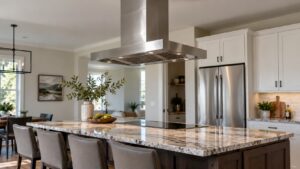
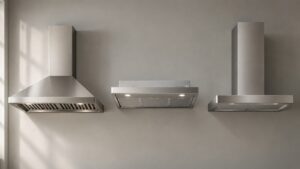
Wolf range hoods come in every installation type to match the cooktop or rangetop below. Pro ventilation includes Pro Wall PW hoods (the PW302210 through PW602718), Pro Wall Chimney PWC hoods (the PWC362418 and PWC482418), and Pro Island PI hoods (the PI423418 and PI543418). The V-Series covers V wall VW (the VW30B, VW36B, and VW45B), V island VI (the VI42S and VI42B), and ceiling VC (the VC48S and VC48W). PL liner inserts (the PL461912 and PL462212) drop into a custom hood enclosure, and DD downdrafts (the DD30, DD36, and DD45) retract into the counter. You can review the current range on the manufacturer’s hub at subzero-wolf.com/wolf and the models we service in our model directory.
Wolf range hoods technologies that matter
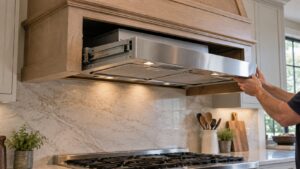
A Wolf range hood is built around its blower, its filters, and its controls. Pro hoods use heavy baffle filters that capture grease efficiently at high extraction rates and wash clean in the dishwasher, while V-Series models use mesh filters; both are sized to clear the heat and steam that Wolf’s high-output dual-stacked burners produce. LED lighting illuminates the cooking surface, and multi-speed controls let you match extraction to the cooking. V-Series hoods add two maintenance reminders — FG prompts you to clean the grease filters after roughly 100 hours of use on a vented install, and FC prompts you to clean the recirculation filters; these are reminders, not problems, and FF simply confirms the reset. A liner insert (PL) hides the blower inside custom millwork, and a downdraft (DD) rises from the counter on a motorized track when you need it and retracts when you don’t. Because the blower motor, the baffle or mesh filters, the backdraft damper, the control board, and the downdraft lift mechanism vary by model, parts matched to your model number are essential for any repair.
Common Wolf range hoods problems
Wolf range hoods report trouble through observable symptoms and the two V-Series filter reminders, not an error-code table:
- Weak suction — the most common complaint; usually clogged grease mesh or baffle filters, sometimes a weak motor.
- Blower won’t run — an unseated motor plug, a worn bearing (often a hum first), or a control failure.
- Fan noise — loose screws, debris, or a misaligned blower wheel.
- Lights or fan dead — a fuse, the breaker, or a switch.
- FG / FC showing — a routine clean-the-filters reminder, not a problem; FF confirms the reset.
- Downdraft won’t raise or lower — the lift mechanism, its motor, or the remote control.
Maintenance essentials
- Wash the baffle filters in the dishwasher regularly, and clean mesh filters when the FG/FC reminder appears.
- Never run the hood without its filters in place.
- Wipe exterior surfaces with stainless cleaner and clear the backdraft damper of grease.
- Replace LED lamps promptly so a failed lamp doesn’t stress the driver.
- On a downdraft, keep the track and rising panel clear of debris so it raises and lowers freely.
Choosing and installing a Wolf range hood
A Wolf range hood is chosen first by mounting style and then sized to the cooking surface and its heat output. A wall hood (PW or VW) mounts above a cooktop set against a wall, an island hood (PI or VI) drops from the ceiling over an island cooktop, and a ceiling hood (VC) mounts flush overhead for a clean line. If you want a custom enclosure built to match your cabinetry, a PL liner insert hides the working hood inside millwork, and where an overhead hood isn’t possible a DD downdraft rises from behind the cooktop and retracts out of sight. The key sizing rule is that the hood should be at least as wide as the cooktop or rangetop below — ideally wider — and powerful enough to clear the heat and steam from Wolf’s high-output dual-stacked burners, French top, or wok burner, so a pro hood is paired with a pro cooktop or rangetop. Ducted (vented) installs exhaust to the outside and clear the air most effectively, while recirculating installs filter and return the air where outside venting isn’t possible. Confirming the exact model and mounting style lets a technician bring the correct blower, filter, damper, board, or downdraft lift part. For the rangetop these hoods pair with, see our rangetop repair page.
When to call for Wolf range hood repair
Blower motors, backdraft dampers, control boards, and downdraft lift mechanisms are best handled by experienced technicians who can isolate the problem and fit Wolf-specific parts from trusted suppliers. Note the symptom and your model number when you book. Diagnostic visits start from $129, with a labor guarantee on the workmanship; the total depends on parts and configuration. Schedule Wolf range hood repair or book an appointment online.