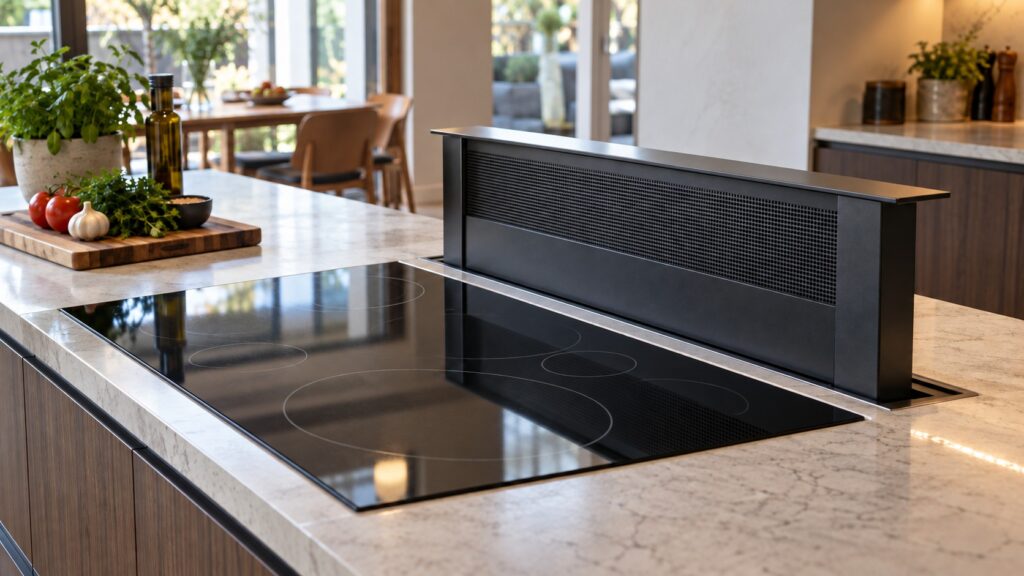
A downdraft is two appliances in one slot: a lift mechanism and a ventilation system. That matters for the wolf downdraft repair or replace decision, because one half can fail completely while the other is perfect — and the half that failed largely determines the answer. It also sits inside a counter and a cabinet, which makes replacement a carpentry question as much as an appliance one.
Separate the halves before you decide anything
Switch it on and watch. If the panel rises normally and the blower is quiet or weak, the fault is in the ventilation half — blower, filters, duct or the control that drives the blower. If the blower runs audibly and the panel will not rise, the fault is in the lift half — motor, drive, track or an obstruction.
That ten-second observation is worth more than any amount of guessing, because the two halves have different parts, different costs and different likelihoods. Our will not raise or lower guide covers the first case and the weak suction guide the second.
Rule out the free causes first
A remarkable share of downdraft calls end without a part.
- Saturated grease filters. They restrict airflow long before they look bad. Wash them and re-test.
- A blocked retraction slot. Grease and crumbs in the slot make a panel stick or rise unevenly.
- An exhausted charcoal filter on a recirculating unit. It does nothing once saturated and it does not wash.
- A duct choked with years of grease, which narrows the effective diameter without any component failing.
- An exterior cap that no longer opens, or that someone has fitted a screen to.
Work through those before accepting any diagnosis, because a clean filter and a clear cap have resolved more of these than any part we carry.
What is worth repairing
Blower motors and lift motors are both standard replacements on this kind of appliance. Switches and control boards are straightforward. A track that has seized from grease usually cleans rather than replaces. Filters are consumables.
A unit in the first half of its life with one of those faults is a repair without much discussion, and that is true even when the part is not cheap, because the alternative involves the counter.
What ends the conversation
A panel that is cracked, bent or distorted is the clearest case. It has to seal into the counter slot and run true in its track, and a damaged one does neither. Corrosion through the chassis is similar.
Two major failures together on an older unit — say a lift mechanism and a blower — is where the arithmetic usually turns, not because either is unreasonable alone but because the total approaches replacement while the rest of the appliance is the same age.
The cutout, which decides more than the price does
This is where downdrafts differ from almost every other appliance. The unit sits in a slot cut through the countertop, with the blower and mechanism in the cabinet below. Cutouts are model-specific, and a replacement that is a fraction different leaves a gap or does not fit.
On a stone counter, enlarging or adjusting a cutout is specialist work with a real risk of cracking. On any counter, a replacement unit with a different footprint can mean a new countertop section.
So before comparing a repair against a new unit’s price, find out whether a current model matches your opening. If it does, the comparison is ordinary. If it does not, the replacement path includes fabrication and the repair becomes clearly the better answer for longer.
Cabinet access, the other hidden cost
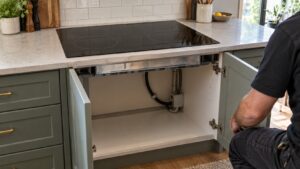
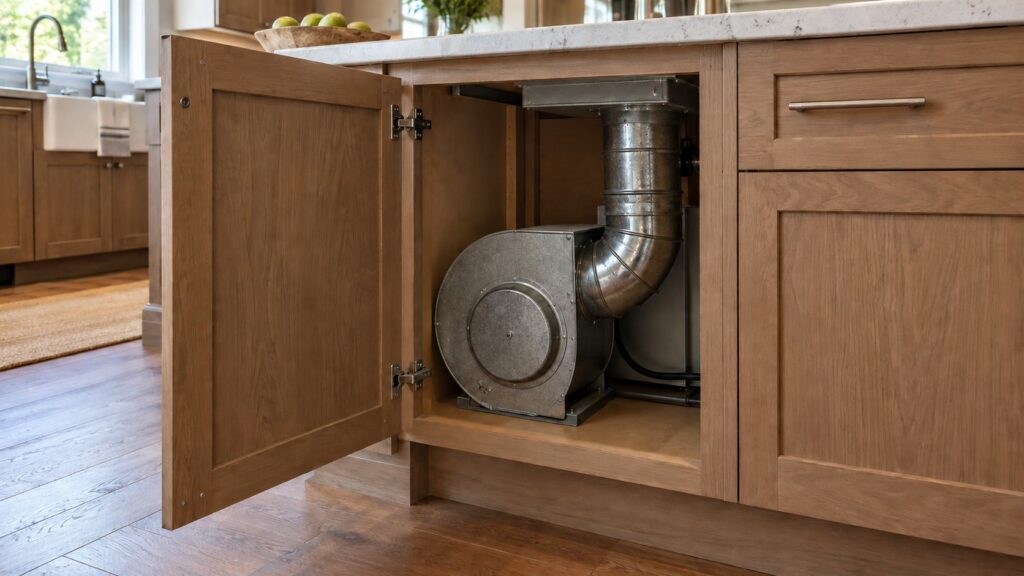
The blower and the lift mechanism live under the counter, and how they were installed decides how expensive any future work is. A unit reachable through a cabinet door is straightforward; one walled in behind fixed panels means carpentry before the appliance work starts.
If you are facing a repair on an inaccessible unit, it is worth improving that access while it is open. The next visit will be cheaper for it, and there will be a next visit eventually.
Age, history and parts
Count the repairs rather than the years. A twelve-year-old downdraft on its first fault has been reliable; one that has had a control and a lift motor and now wants a blower is telling you where it is going.
Ask about parts availability at the same time, because it frequently decides the question on its own. A motor still in production means the appliance is fixable now and fixable again; one available only as a salvage part means this repair is the last one. Our hood repair against replace guide covers the same reasoning for overhead units.
A sensible way to proceed
Get a diagnosis before pricing anything. Establish which half failed, which part, whether it is available, and what the cutout situation is. Then compare the repair against the full replacement cost — appliance, removal, fitting, and any counter or cabinet work. On a built-in downdraft that total is usually considerably larger than the sticker suggests.
When to call
Call when the panel will not move, when it moves partway and stops, when the blower runs without moving air despite clean filters, when the unit has become noisy in a way it was not before, or when you need an honest answer on whether a current model fits your opening.
We are an independent repair company and not a factory service arm. Pricing starts from a diagnostic visit and we confirm the estimate before any work begins — including telling you when replacing makes more sense than repairing. Wolf range hood repair covers blowers, motors, controls and lift mechanisms, and you can schedule a visit online.