What E1 means (wolf e1 error)
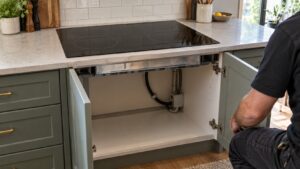
A wolf e1 error on a legacy CT induction cooktop means the ambient temperature around the electronics is too high — the induction generator is overheating, often because airflow is restricted. Improving ventilation frequently clears it.
Symptoms to look for
The signs below help confirm you are dealing with this condition rather than a different problem on your Wolf cooktop. You may see one of them or several together, and they can appear gradually or suddenly after a power event, a self-clean cycle, a spill, or recent service.
- “E1” shows on the legacy CT cooktop
- Zones cut out during longer cooking
- The cabinet space feels hot or poorly ventilated
- The problem eases when the cooktop cools
Common causes
Several different problems can produce these symptoms. Working through the most likely causes in order separates a quick owner-level check from a problem that needs trained service and the correct Wolf parts.
- Restricted airflow — blocked vents or tight cabinetry
- Failed or weak cooling fan — airflow is reduced
- High room temperature — the surroundings are very warm
- Ambient sensor failure — the control misreads heat
Troubleshooting steps you can try
Work through these checks in order before calling for service. Stop wherever you are unsure, or where mains voltage, gas, a hot oven cavity, or a sealed component is involved, and hand the rest to a qualified technician.
- Make sure the cooktop vents and cabinet openings are clear.
- Let the cooktop cool, then resume at a lower sustained power.
- Turn it off at the breaker for 30 to 60 seconds, then restore power.
- If “E1” recurs with good ventilation, leave it for service.
Parts a technician may replace
Depending on what the diagnosis shows, a technician may inspect, test, or replace the cooling fan, vent/intake, ambient sensor, and control board. The correct part for your Wolf cooktop is matched from the model and serial number, and genuine Wolf components are fitted through trusted parts suppliers rather than generic substitutes so that performance, safety, and the appliance’s long working life are all protected. Confirming the failed part before ordering avoids replacing more than the problem actually requires.
When to call a technician
A recurring E1 with good ventilation needs a technician to test the cooling fan and ambient sensor. When the fix calls for trained service, book a visit through our scheduling page and an experienced, qualified technician will diagnose and repair it.
Prevention and care
Regular care keeps this condition from returning on your Wolf cooktop. Keep filters, vents, burner ports, igniters, seals, and the cooling-fan path clean, avoid blocking airflow, check that doors and knobs seat cleanly, and follow the Wolf use-and-care guidance for your model. Because this unit relies on electronic control, protect it with a stable, correctly rated power supply and have any built-in installation done to Wolf specification so the control never sees an out-of-range condition. If a code appears, note exactly what was shown before you reset the appliance at the breaker — that record helps the technician reach an accurate diagnosis and avoid replacing parts unnecessarily.
Related help and Wolf resources
Browse other Wolf Cooktop diagnostics, read about Wolf Cooktop repair, look up your unit in the Wolf models reference, or the related E3 heatsink high, or schedule a service visit. For Wolf manufacturer documentation and model lookup, visit the manufacturer at subzero-wolf.com.