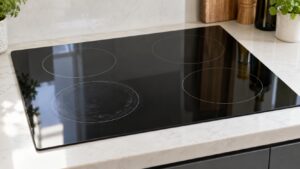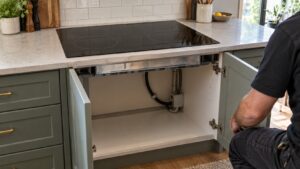
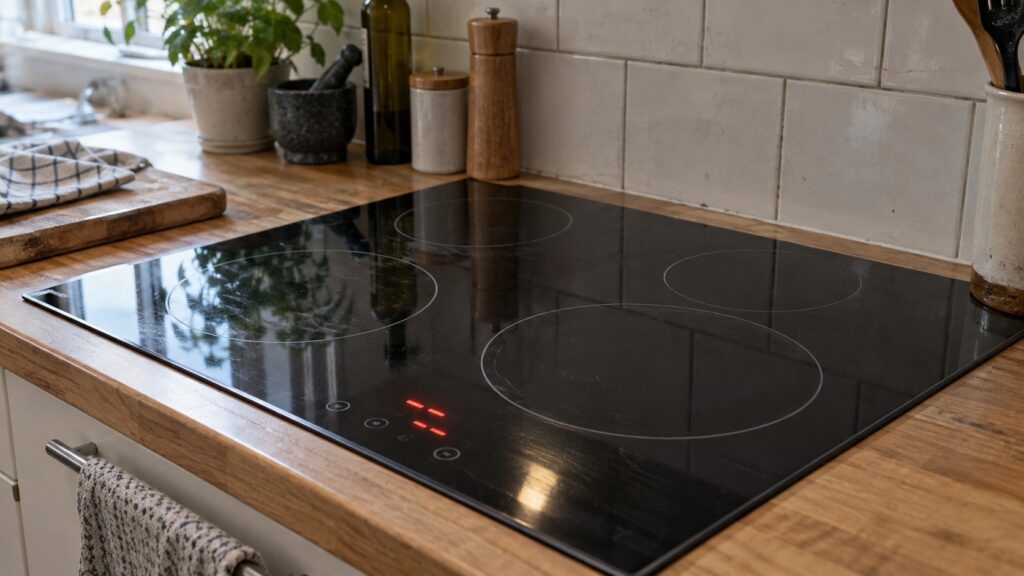
A legacy Wolf induction cooktop from the CT line uses a different generator and sensor electronics than the newer CTE-series ribbon-control models, and its fault numbers reflect that older design. A wolf ct induction cooktop e41 error is not the same family as the E01-through-E18 codes on a current CTE panel, even though both start with the letter E — they come from different generations of hardware with different failure points, and reading the wrong code list sends you looking at the wrong component entirely.
What sets the CT-series codes apart from the newer CTE codes?
Wolf’s current CTE-series cooktops use a touch-ribbon control panel and report faults numbered E01 through E18, covering that panel’s own electronics — a separate list our Wolf CT cooktop E01-E18 codes guide covers in full. The CT-series covered here is an earlier generation of induction cooktop built around a different generator and sensor layout, and its fault numbers — E10, E31, E41, E43 and E53 — describe failures in that older hardware specifically. Searching a bare number without knowing which generation is installed is how a legacy CT fault ends up compared against the wrong list.
What does an E41 or E53 actually mean on a legacy CT cooktop?
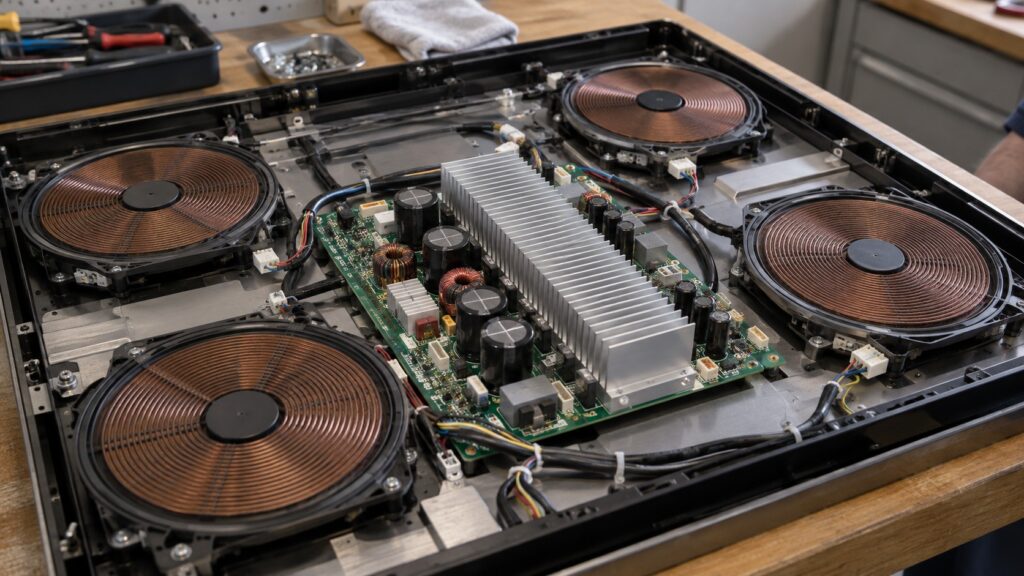
Both point at temperature-sensing hardware, but at two different components. E41 indicates the temperature sensor itself has shorted, while E53 points at a shorted thermistor — a related but physically separate part in the same sensing circuit. In practice both produce similar symptoms on the display: a zone that shuts itself down mid-cook, or refuses to hold a setting, because the control board cannot trust the temperature reading it is getting. Distinguishing which of the two codes is showing matters for ordering the correct part, even though the customer-facing symptom looks almost identical.
What do E10 and E43 mean, and how are they different from each other?
E10 is a generator communication problem — the control board and the induction generator board are not talking to each other reliably, which can be a loose connector as easily as a failed board. E43 is a step further: an outright induction generator failure, meaning the generator itself is no longer producing the field needed to heat a pan on that zone at all. E10 is worth checking connections for before assuming a part has failed; E43 usually means the generator board itself needs replacement.
What does an E31 burner ON-LED failure actually affect?
This code is narrower than the others on this list — it points at the indicator LED that confirms a burner zone is active, not at the heating or sensing circuit itself. A cooktop showing E31 may still heat normally; what has failed is the visual confirmation that a zone is on, which matters for safety awareness (knowing a zone is hot after cooking) more than for cooking performance in the moment.
Why do E10 and E43 sometimes get confused with each other in the field?
Both faults trace back to the same generator subsystem, and on a cooktop that has started showing intermittent zone dropouts before settling on one code, it is easy to assume the two are stages of the same failure. They are related but not identical: E10 describes a communication breakdown, which can sometimes be a connector, a harness, or noise on the data line between boards rather than a failed part outright. E43 describes the generator itself failing to produce output, which points squarely at the generator board regardless of whether communication with it is otherwise fine. A cooktop can show E10 for weeks on an intermittent connection and never progress to E43 at all, or it can jump straight to E43 with no preceding communication symptoms. Treating them as the same fault risks ordering a generator board when the actual problem was a loose harness connector, or vice versa.
What can you check yourself before calling for service?
Power-cycle the cooktop at the breaker for a full two minutes, since a communication fault like E10 sometimes clears on restart if the underlying connection is intermittent rather than fully failed. Beyond that, these are internal electronic faults behind a sealed cooktop surface, and none of them are safe or productive to chase further without opening the unit — that step is where we recommend stopping and having a technician confirm which component in the generator or sensor circuit is actually at fault.
Why does it matter that this is described as a “legacy” cooktop?
It is also worth knowing whether sourcing a used generator board makes sense once a fault is confirmed to be hardware, not just a connector. It can be a reasonable option, provided the source is reliable and the part is confirmed to match the exact model rather than just the general CT family. Because this is an older cooktop generation, a factory-new generator board is not always as readily available as it would be for a current CTE model, and a functional used board can be a reasonable middle path between a full repair at new-part pricing and giving up on the cooktop entirely. What matters most is confirming compatibility against the specific model number on the cooktop’s own data plate before committing to a part, since even within the CT family, minor revisions exist that are not always interchangeable.
Wolf’s own error-code documentation for these codes specifically labels the CT-series as a legacy product line, distinct from the CTE models currently sold. If you are unsure which generation is installed, the model number on the cooktop’s own data plate — not the fault code alone — is the fastest way to confirm it, since CT and CTE model numbers are not interchangeable and neither are their parts. Our Wolf cooktop fan error E8 guide covers a related but separate fault that appears on cooling-fan equipped models, worth ruling out if the display is showing more than one code in sequence.
We are an independent repair service, not a factory-authorized channel, and our technicians carry diagnostics for both the legacy CT generation and the current CTE line. If your cooktop is showing any of the codes above, Wolf cooktop repair covers diagnosis and parts for both generations, and you can schedule a visit with the exact code and model number ready to describe.