
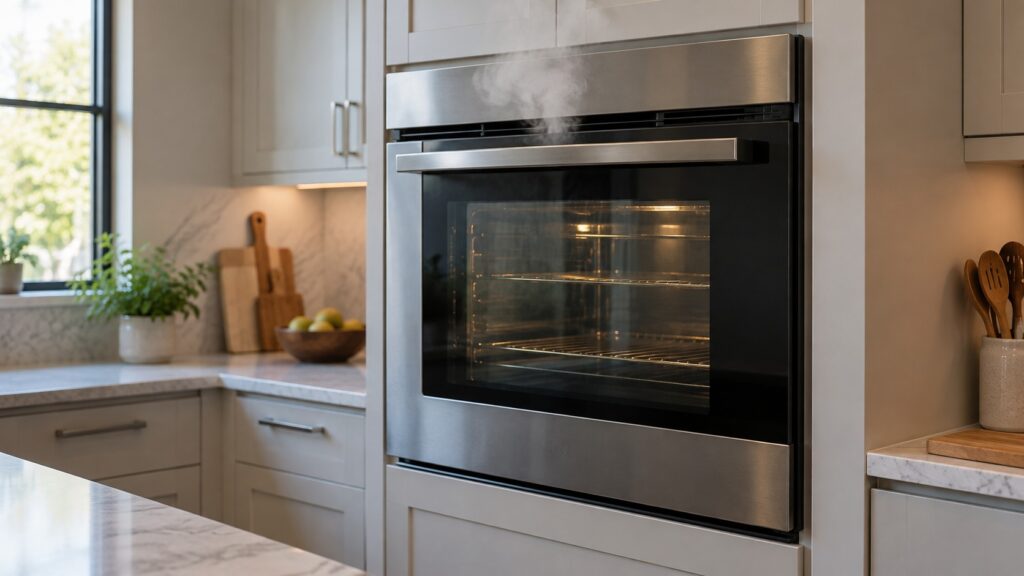
A Wolf CSO — Convection Steam Oven — does not fill its cavity with steam the way a stovetop kettle fogs a window. It boils a small, separate reservoir of water into steam on demand, injects that steam through a port at the back of the cavity, and blends it with convected heat in ratios the control board adjusts for the program selected. Understanding the wolf cso boiler and injection port explains two things at once: why the CSO can cook a dish that a standard convection oven cannot, and why the maintenance routine every CSO eventually needs traces straight back to that same boiler.
Where does the steam in a Wolf CSO actually come from?
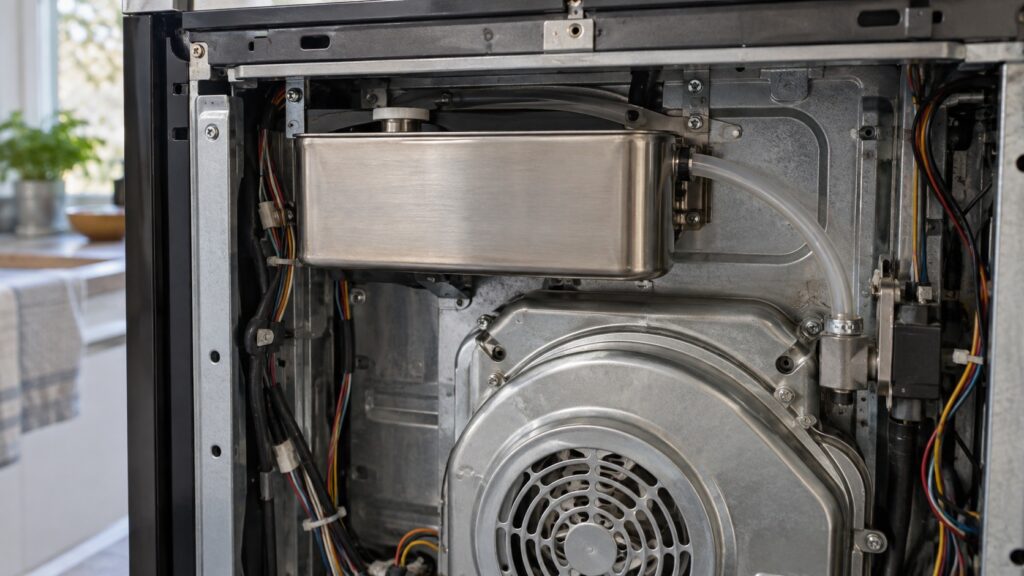
The water never touches the food cavity directly. It sits in a small, refillable reservoir that the oven draws from only when a program calls for steam, and a dedicated heating element inside a separate boiler chamber raises that water to boiling point. What reaches the cooking cavity is the vapor produced in that chamber, pushed through a fixed injection port, not water splashing off a hot surface. That separation is deliberate: it lets the control board meter exactly how much steam enters the cavity per minute, rather than guessing from how hot the walls happen to be.
How does the oven combine steam with convection heat?
Pure Steam mode shuts the convection fan and heating elements out of the equation almost entirely, running the cavity at or near 212°F with steam alone — the setting used for delicate fish, vegetables, or reheating without drying anything out. Convection Steam blends the two: the fan and elements run a normal bake or roast cycle while the boiler injects timed pulses of steam into that same airflow, which is what lets a CSO produce a roast with a browned exterior and a moist interior in one program instead of two.
Why does the control board only add steam in short bursts, not continuously?
Continuous steam injection would quickly saturate the cavity past what a given recipe needs and start condensing on the door glass and cavity walls instead of doing useful work on the food. The control board instead pulses the boiler on and off based on a humidity target for the selected program, which is also why a CSO cycle sounds different partway through — a faint hum or click as the boiler element cycles is normal, not a fault.
What in this system actually needs periodic attention?
Every gallon of water run through the boiler leaves behind whatever minerals it carried, and unlike a kettle you empty and refill daily, the CSO’s boiler holds onto that residue cycle after cycle. Over months of steam and combi-steam use, that residue becomes scale on the heating element and the injection port, which is the direct mechanical consequence of the process described above. Our Wolf CSO steam descaling guide walks through the cleaning cycle that clears it before it slows steam output or trips a sensor fault.
What does it look like when the steam-generation system starts to fail?
A boiler or injection fault does not usually announce itself as “steam is weak” — it shows up as a sensor or probe code on the display, because the same electronics that meter steam output also monitor the boiler’s temperature and water level. Our Wolf CSO sensor and probe codes guide covers the specific fault numbers tied to this system, and a related fault pair is broken down in our Wolf CSO E29/F9 guide. Reading the exact code on the display before calling for service tells a technician whether the problem sits in the boiler, the sensor, or the injection path.
Why can’t the CSO just draw steam from a household water line directly?
Plumbing the oven directly to a water supply would remove the need to refill a reservoir, but it would also remove the control the oven currently has over water quality and quantity reaching the boiler. A sealed, refillable reservoir means the oven only ever boils water the user has chosen to add, at a volume small enough that mineral content stays predictable between fills. A direct plumbing line would introduce whatever mineral hardness the household’s own water supply carries, continuously, which would accelerate scale buildup rather than making it more manageable. The reservoir design is a deliberate trade: slightly more hands-on filling in exchange for a boiler that scales at a known, manageable rate rather than an unpredictable one tied to household water hardness.
This also explains why the type of water used matters more with a CSO than with most kitchen appliances. Filtered or distilled water run through the reservoir measurably slows scale accumulation compared with hard tap water, simply because there are fewer minerals in the water reaching the boiler element in the first place. It will not eliminate the need for descaling entirely, but households in areas with notably hard water often find the interval between descaling cycles stretches out meaningfully when they switch what they pour into the reservoir.
How does knowing this mechanism change how you use the oven day to day?
Because the reservoir is small and finite, a long Pure Steam cycle can run the water level low mid-cook on some models, which is why checking the reservoir before starting an extended steam program is worth the ten seconds it takes. It also explains why the CSO reservoir should be emptied between uses rather than left standing — sitting water is exactly what accelerates the mineral buildup that eventually needs descaling.
We are an independent repair company, not a factory-authorized channel, and our technicians carry the diagnostics for the CSO’s boiler, injection port and sensor system specifically. If a steam program has stopped producing visible steam, is throwing a code, or the oven simply will not hold humidity the way it used to, Wolf oven repair covers CSO diagnosis and parts, and you can schedule a visit with the model number and any code shown on the display ready to describe.