The Wolf ovens lineup
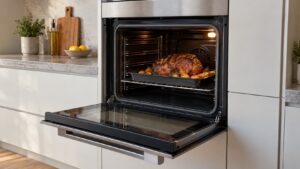
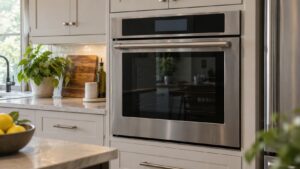
Wolf ovens are built-in wall ovens that install flush in a run of cabinetry, split into three families. The current M Series drives the oven from a 7″ full-color touchscreen — single ovens such as the SO3050CM/S, SO3050TM/S/T, and SO3050PM/S/P, and double ovens such as the DO3050CM/S, DO3050TM/S/T, and DO3050PM/S/P. The legacy E Series covers the SO3050TE/S/T, SO3050PE/S/P, and DO3050TE/S/T. The CSO Convection Steam ovens — the CSO3050PE/S/P, CSO30CM/S, and CSO30TM/S/TH in 24″ and 30″ — add a steam cavity. Suffixes map the style: PM/CM/TM are M Series Professional, Contemporary, and Transitional, and PE/TE are E Series Pro and Transitional. You can review the current range on the manufacturer’s hub at subzero-wolf.com/wolf and the models we service in our model directory.
Wolf ovens technologies that matter
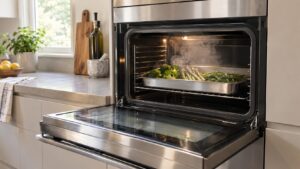
Wolf ovens earn their cooking performance from a deep technology set. Dual VertiCross™ convection circulates heat through twin fans for even results across every rack, while the in-oven infrared broiler sears at high heat. Gourmet Mode offers roughly fifty guided automatic presets that manage time and temperature for you, and a temperature probe cooks to a precise internal target. The M Series adds a 7″ touchscreen interface with on-screen guidance, while the CSO combines convection with steam injection for bread, vegetables, and gentle reheating. Cooking modes include Bake, Broil, Convection, Convection Roast, Dehydrate, Gourmet, Proof, Roast, Stone, and Warm, plus self-clean and Sabbath modes. Because the bake and broil elements, RTD sensor, MDL door lock, convection and cooling fans, steam generator (on CSO), and control board vary by M, E, or CSO build, parts matched to your model number are essential for any repair.
Common Wolf oven problems and codes
Wolf wall ovens use three non-overlapping code schemes — never blend them. The problems we see most often:
- E Series: F1 door-lock failure (common after a self-clean), plus text phrases like “RTD Open”, “RTD Shorted”, “Over Temp”, and “No Bake/Broil element detect”.
- M Series: four-digit numeric codes — 0021/0022 bake relay shorted, 0821/0822 lock relay shorted, 3121/3122 RTD shorted, 4421/4422 cooling fan not detected, and an on-screen “Touch Pad Sensor failure”.
- CSO steam: paired codes — E17/F1 food-probe short, E29/F9 chamber not sealed, and F4/E87 steam generator or temperature sensor.
- Probe readouts “998” (partly inserted) and “0” (not inserted) are status, not problems.
For meanings and next steps, see our Wolf oven error codes.
Maintenance essentials
- Run the self-clean cycle sparingly — the door lock is the most common post-clean problem on every series.
- Descale and empty the water container on CSO convection steam ovens.
- Wipe the door seal and check it holds baking heat.
- Keep the cooling vents clear so the electronics do not overheat.
- If the M Series panel won’t rotate during a clean or cook cycle, that is normal, not a problem.
Planning a Wolf oven installation
A Wolf oven lives in a cabinet cutout, so the install is as important as the oven itself. A single SO oven fits a standard 30″ cutout at a comfortable height and suits a focused kitchen, while a double DO oven stacks two cavities for cooking at two temperatures at once. Pairing a single oven with a CSO convection steam oven in a column adds a steam cavity for bread, vegetables, and gentle reheating alongside conventional baking, and many kitchens build a tall tower that stacks an oven, a steam oven, and a warming drawer. Each oven needs its own correctly rated electrical circuit and clear cooling vents so the cabinetry stays safe during high-heat self-cleaning, and a CSO also needs a route for its water supply or fill container. The choice between M Series and E Series comes down to the interface — the current M Series uses a 7″ touchscreen, while the legacy E Series uses physical controls. Confirming whether you own an SO, DO, or CSO model, the series, and the exact model lets a technician bring the right door, element, lock, steam, or board part.
When to call for Wolf oven repair
Heating elements, RTD sensors, MDL self-clean locks, steam systems, touchscreen panels, and control boards are best handled by experienced technicians who can read the correct E, M, or CSO codes and fit Wolf-specific parts from trusted suppliers. Note the exact code and your model number when you book. Diagnostic visits start from $129, with a labor guarantee on the workmanship; the total depends on parts and configuration. Schedule Wolf oven repair or book an appointment online.