Four of the codes a Wolf convection steam oven can print are about measurement rather than steam: E09 is a short in the PT temperature sensor, E17 (shown on some controls as E17/F1) is a short in the food probe, E18 is the opposite — food-probe resistance too high — and F4, paired with E87, is a steam generator or temperature-sensor failure. Two of them stop you cooking entirely, two of them only stop probe cooking, and knowing which is which saves a service call.
What are the Wolf CSO oven sensor codes telling me?
A convection steam oven measures temperature in more places than a conventional one. There is a cavity sensor that governs the set temperature, a probe jack for the plug-in food probe, and sensing on the steam generator that decides when water is hot enough to produce steam. The Wolf CSO oven sensor codes each name one of those circuits and the direction in which it failed.
Direction is the detail most people skip. A temperature sensor is a resistor whose value changes with heat, and the control reads that value continuously. If the value collapses toward zero, the circuit is shorted; if it climbs beyond the top of the scale, the circuit is open. E17 and E18 are the same probe circuit reported in those two directions, which is why they can alternate on the same oven as a damaged cable moves.
That also tells you what to look at. A short usually comes from moisture, a pinched cable or a crushed connector. An open usually comes from a broken conductor or a plug that is not fully seated. If you have a background on the appliance itself, our glossary entry on the CSO convection steam oven sets out what the sensors are there to do.
Which of these codes stop the oven and which do not?
E09 is the serious one. The PT sensor is how the oven knows the cavity temperature, so a shorted reading means it cannot hold a set point safely and it will refuse to run. Nothing you do in the kitchen will get around that, and it should not be worked around.
E17 and E18 are narrower. They concern the food probe circuit only, so on many controls the oven will still run ordinary convection and steam programs while refusing anything that uses the probe. That gives you a useful test and a useful workaround at the same time: unplug the probe, power the oven down for two minutes, and try a plain bake. If the oven cooks normally without the probe, the fault is confined to the probe and its jack.
F4 with E87 sits between the two. The steam side is what is reported, so convection may continue while steam and combination modes fail or produce no steam at all. Treat any oven that is heating but producing no steam as a candidate for this code even if the display has been cleared.
Can a food probe cause E17 or E18 on its own?
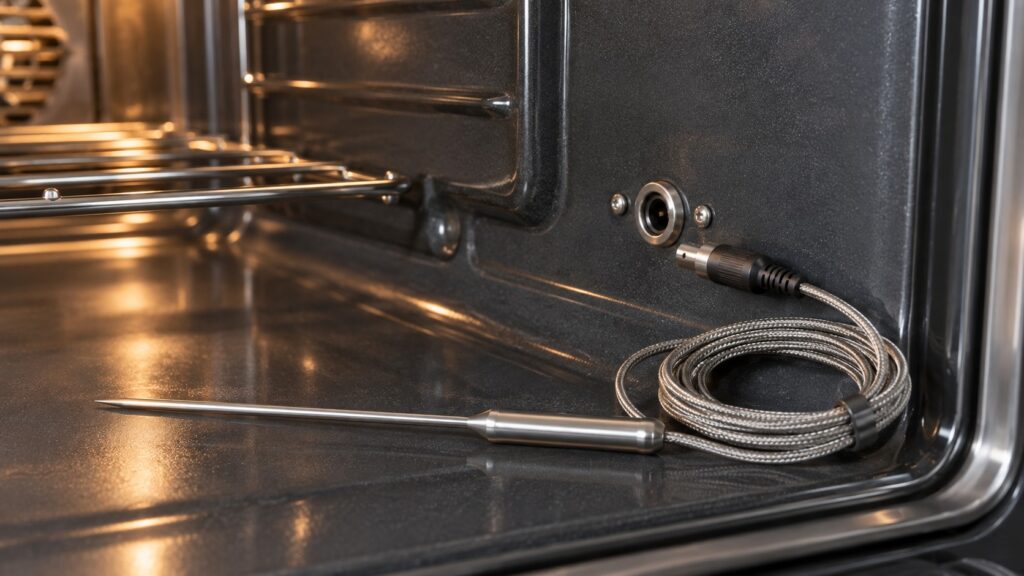
Yes, and it is the most common reason both codes appear. The probe is the only sensor in the appliance that gets handled, washed, coiled and pushed into a hot cavity by hand, and the cable is the part that fails — usually where it meets the plug or where it has been bent over the oven rack edge again and again.
Before anyone opens the oven, work through the probe itself:
- Unplug the probe and run the oven without it. If the code goes away and stays away, you have found the side the fault is on.
- Look along the cable. A kink, a flattened section or a split near the plug is enough to produce either code.
- Check the jack. Food debris or standing water in the socket produces a short that looks exactly like a failed probe.
- Try a second probe if you own one. A probe from another Wolf appliance is a fast way to separate the accessory from the appliance.
Never wash a probe by immersing it or put it in a dishwasher. Water that gets inside the cable sheath migrates toward the plug and shows up weeks later as an intermittent E17. Our notes on the Wolf temperature probe explain what the accessory is doing and how it should be handled.
Why does F4 appear with E87?
F4 and E87 describe a steam generator or temperature-sensor failure on a Wolf CSO steam oven. The generator is a small heated vessel with its own sensing, and the code is raised when the control cannot bring it to temperature, or cannot read its temperature at all.
There is a benign version and a real one. The benign version is scale. A generator carrying months of mineral deposit heats slowly and unevenly, and the control eventually decides the reading is wrong. If the oven has not been descaled on schedule and the water is hard, run the descale procedure first — descaling a Wolf CSO steam oven walks through it — and see whether the code returns.
The real version is a failed heating element or sensor inside the generator, and that is a sealed, pressurized assembly. It is not a component to investigate with the oven warm, and it is not one to open at all outside of service.
How do I tell these apart from a sealing fault?
Wolf steam ovens also print E29 with F9, and that is a different family altogether: the steam chamber is not sealed. It produces symptoms that feel similar from the kitchen — steam modes failing, condensation where there should not be any — but the fix lives at the door and the gasket rather than in a sensor circuit. We cover it separately in the guide on the Wolf CSO E29 and F9 codes.
The simplest separator is what you can see. A sealing fault usually leaves visible evidence: steam escaping at the door edge, water on the counter below the door, a gasket standing proud of its groove. A sensor fault leaves nothing visible at all — the oven just stops and prints a number.
What should I write down before calling?
These four codes are diagnosed from a short set of facts, and all of them come from the kitchen rather than from a meter:
- The exact characters, including whether the display alternated between two of them. E17 alternating with F1 is one code, not two faults.
- Whether the probe was plugged in when it happened, and whether the oven runs without it.
- Whether the oven was in a steam, convection or combination mode.
- Whether there is scale visible in the water tank or the cavity, and when the oven was last descaled.
- Whether the code is instant on power-up or appears only after the oven has been hot for a while.
That last one matters more than it sounds. A fault present from a cold start is a failed component. A fault that only appears once everything has expanded is a connection, and it will be found faster if the technician knows to look for it warm.
When does a CSO code need a technician?
E09 needs one, because the cavity sensor governs safe operation. F4 with E87 needs one once descaling has been ruled out, because the generator is a sealed assembly. E17 and E18 need one only when a known-good probe still produces the code, which points at the jack or the harness behind the control panel.
We are an independent repair company, not a factory service arm. Pricing starts from a diagnostic visit and we confirm the estimate before any work begins. Call (844) 991-2780 with the code and what the oven was doing, or schedule a visit. Our Wolf oven repair service covers the probe circuit, the cavity sensor and the steam generator on the CSO family.