If a legacy Wolf CT electric cooktop stops heating and prints a two-character E code, the code is telling you which measurement the control lost, not which part failed. Six of them come up on the CT family: E01 and E02 are heat conditions the board is protecting itself from, E05 is a temperature sensor reading that went open, E07 says the stored configuration no longer matches the appliance, and E09 and E18 are the two halves of a control failure — one in the keyboard link, one in the power board itself.
What do Wolf CT cooktop error codes tell you?
A Wolf CT electric cooktop does not watch cooking. It watches a short list of electrical facts: the resistance of a thermistor, the temperature of its own heatsink, whether the touch panel answers when the board speaks to it, and whether the configuration stored in memory matches the appliance it is installed in. When one of those readings falls outside the window the firmware expects, the cooktop stops the affected element and prints a code.
This is why the codes cluster the way they do. There is nothing in the list about a burner being weak or a pan heating unevenly, because the control has no way to measure that. Every one of these six codes describes either heat where the electronics live or a break in the electronics themselves. That narrows the search a great deal before you have touched anything.
It also means the code is a symptom of a condition, not a diagnosis of a part. E05 says the thermistor circuit reads open. The thermistor itself, the two wires that run to it, and the connector at the board are all in that circuit, and any of the three produces the same code.
Why does a CT cooktop show E01 or E02?
These two are the most misread codes on the family, because people assume the cooktop overheated while cooking. It usually did not. E01 is about the air around the electronics, and E02 is about the aluminum heatsink that carries heat away from the power components. Both are almost always installation or airflow faults rather than component failures.
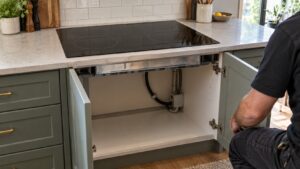
An electric cooktop is built to breathe. It pulls cooler air from the cabinet below, moves it across the underside of the glass and the heatsink, and pushes it out again. When that path is blocked, the board is the first thing to complain. The usual causes are worth knowing because they are all fixable without a part:
- A drawer or cabinet packed tight underneath. Pans stacked against the underside of the appliance close the intake.
- A wall oven directly below with no separation. A self-clean cycle in the oven underneath can push the cooktop into E01 all on its own, and the code clears once the oven has cooled.
- Insulation or shelf liner added after installation. Anything laid across the cabinet opening changes the airflow the appliance was designed around.
- A blocked or reduced cutout. If the countertop was replaced, the opening may no longer match what the appliance needs. Our notes on Wolf cooktop installation cover the clearances that matter.
If E01 or E02 appears only during long, hard use — a full pot boiling on several elements for an hour — treat it as an airflow problem first. If it appears within minutes of switching on a cold appliance, the sensor reading is more likely at fault than the actual temperature.
What does E05 mean on a Wolf CT cooktop?
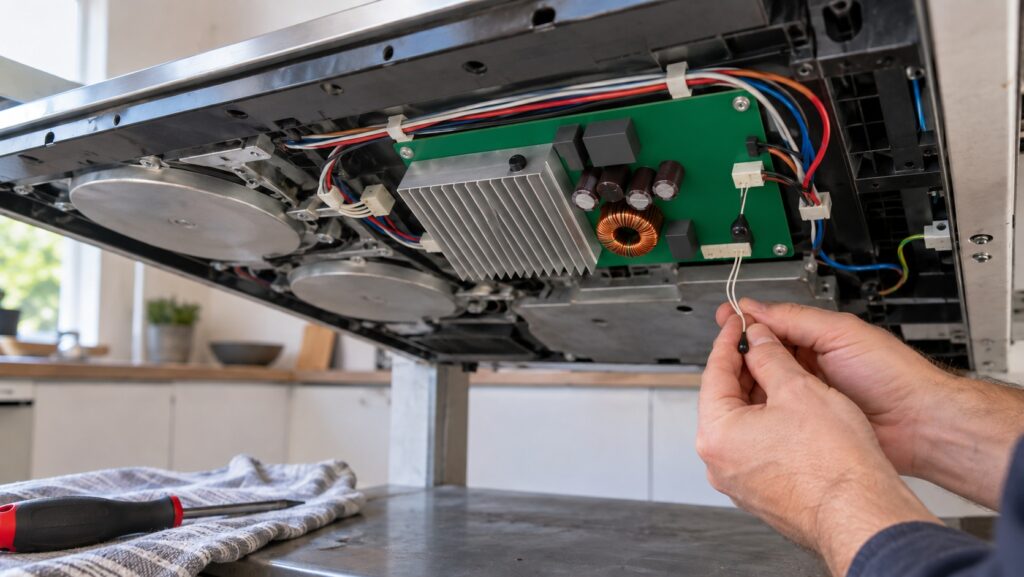
E05 is an open ambient thermistor: the sensor that feeds E01 its number has stopped reporting. Electrically, open means the circuit is broken somewhere between the board input and the sensor body. Practically, it means the cooktop no longer knows how hot it is inside, so it refuses to run rather than guess.
This is the one code in the group where a repeated pattern is informative. A thermistor that has genuinely failed gives E05 constantly, from the moment power is restored. A connector that has worked loose in the heat gives E05 intermittently, often after the appliance has been running a while and the plastic has expanded. Write down which of the two you are seeing before anyone opens the appliance — it is the difference between replacing a sensor and reseating a plug.
You can read the site entry for the Wolf E05 cooktop error alongside the related heat codes, because on a CT cooktop they share a circuit and often appear in sequence.
Why would a cooktop report E07 after a repair?
E07 means a model or configuration value changed. It is unusual among Wolf CT cooktop error codes because it is rarely caused by wear — it is caused by work. A replacement control board arrives with a generic configuration, and if it is not set to the exact appliance it has been fitted to, the board knows the stored value does not match what it can see and prints E07.
So if a CT cooktop starts showing E07 within days of a board replacement, a power supply problem or a lightning event, the configuration is the first thing to check, not the last. The fix is a setup step rather than a part. A homeowner cannot perform it, and there is no keypad sequence worth publishing here, because the values differ between widths and between electric and induction versions of the same cabinet.
Are E09 and E18 the same problem?
They are neighbors, not twins. E09 is a keyboard communication problem: the power board is alive and asking questions, and the touch control is not answering. E18 is a power-board failure: the board that drives the elements has reported its own fault. One points at the panel and its ribbon, the other at the board behind it.
The reason they get confused is that both can look identical from the kitchen — a cooktop that lights up and refuses to heat, or a panel that responds to nothing. The display is what separates them, so read it before you power-cycle the appliance. If a touch panel is simply unresponsive with no code at all, that is a different subject again, covered in our guide to unresponsive Wolf cooktop controls.
Neither E09 nor E18 is a homeowner repair. Both sit behind the glass, on a chassis that carries a 240-volt supply, and the parts are matched to the serial number of the appliance.
What can I check before calling for service?
Four checks are safe, take ten minutes, and resolve a fair share of the heat-related codes:
- Cut power at the breaker for two minutes. Several of these codes are latched. A code that returns instantly is reporting a live condition; a code that stays away is reporting something that has already passed.
- Empty the cabinet underneath. Then run the cooktop normally for half an hour and see whether E01 or E02 comes back.
- Note what else was running. A wall oven in self-clean below the cooktop is a common and completely benign cause of a heat code.
- Write the code down exactly. E09 and E09 on a different Wolf appliance family are not the same fault, and the digits matter more than the letter.
Stop before lifting the glass or removing the underside panel. The element wiring and the power board are both live at 240 volts, and the glass is bonded to a frame that does not survive being pried.
When is a CT cooktop code worth repairing?
An airflow-driven E01 costs nothing to fix and should never lead to a replacement. A failed thermistor is a small part. E18 and E09 are board-level repairs, and on a legacy CT cabinet the honest question is whether parts are still available for that specific width and configuration — which is exactly the conversation in our guide on repairing or replacing a Wolf cooktop.
We are an independent repair company, not a factory service arm. Pricing starts from a diagnostic visit and we confirm the estimate before any work begins. If your cooktop is holding a code you cannot clear, call (844) 991-2780 with the exact characters on the display, or schedule a visit. Our Wolf cooktop repair service covers the sensors, panels and boards behind all six of these codes.