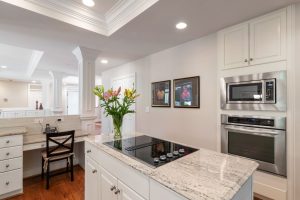
The Wolf microwaves lineup
Wolf microwaves come in five styles to suit different installations. The drawer (MD) microwave — the MD24TE/S, MD30TE/S, and MD30PE/S — pulls open like a drawer beneath the counter and has no turntable. The drop-down door (MDD) models — the MDD3050TM/S/T, MDD3050PE/S/P, and MDD3050CM/B/T — install in a tall cabinet. The convection (MC), standard (MS), and speed (SPO) ovens — including the MC24, MS24, and the SPO3050TM/S/T and SPO3050PE/S/P — round out the range in 24″ and 30″ widths. Unlike the MD/MWD drawer, the MDD, MC, MS, and SPO models use a turntable. You can review the current range on the manufacturer’s hub at subzero-wolf.com/wolf and the models we service in our model directory.
Wolf microwaves technologies that matter
Each Wolf microwave style serves a different purpose. The drawer (MD) design opens at counter or below-counter height, frees up wall space, and — having no rotating turntable — heats from below for even coverage across the full floor of the cavity. The convection (MC) oven adds a heating element and fan so it can bake and roast as well as microwave, the speed (SPO) oven combines microwave and convection for fast results, and the standard (MS) oven covers everyday reheating and defrosting. Many models include sensor cooking and Gourmet presets that read humidity to set time and power automatically. Because the magnetron, high-voltage capacitor and diode, door interlock switches, the monitor fuse, the drawer motor and slide (on MD/MDD), and the control board vary by style, parts matched to your model number are essential for any repair — and the door-interlock system in particular is a safety-critical assembly.
Common Wolf microwave problems
Wolf microwaves show status words rather than a numeric problem table, so most issues are diagnosed by symptom:
- Not heating — check DEMO (showroom) mode first; it disables heat by design and is the number-one cause on a new install. After that, the magnetron, high-voltage capacitor, or diode.
- Drawer won’t open or close — the control lock, an obstruction or overfill, the position switch, the drawer motor, or a slide misalignment (MD/MDD only).
- Completely dead — the power supply, the LCD board, or a door switch.
- Touchpad unresponsive — the control lock (LOCK ON) or cabinet pressure on the panel.
- Blows the monitor fuse — a door-interlock failure; stop using the unit until it is repaired.
- PF after an outage, or END at the close of a cycle, are status messages, not problems.
Maintenance essentials
- Know how to exit DEMO/showroom mode so it is not mistaken for a “not heating” problem.
- Keep the drawer slides and the cavity floor clean so the drawer moves freely (MD/MDD).
- Wipe the door and check the interlock area stays clear so the latches seat.
- Wipe the humidity-sensor area so sensor and Gourmet cooking read correctly.
- Stop using the unit if it ever runs with the door open or blows a fuse — the interlock is safety-critical.
Choosing and installing a Wolf microwave
A Wolf microwave is chosen by where it will live and what it needs to do. The drawer (MD) model is the most flexible for placement — it installs in a base cabinet or island below the counter, opens with a pull at a comfortable height, and frees the wall for other appliances, and because it has no turntable it accepts a wider dish than a turntable cavity of the same size. A drop-down (MDD) model suits a tall cabinet at eye level. If you want one appliance to bake, roast, and microwave, the convection (MC) or speed (SPO) oven combines those functions and can stand in for a second oven in a compact kitchen, while a standard (MS) oven covers straightforward reheating. Each unit needs its own correctly rated outlet and adequate ventilation clearance so it sheds heat, and a built-in drawer or speed oven needs a cutout sized to the exact model. Confirming the exact MD, MDD, MC, MS, or SPO model lets a technician bring the correct magnetron, door switch, drawer motor, fuse, or board part. For the wall ovens these often pair with in a tower, see our oven repair page.
When to call for Wolf microwave repair
Magnetrons, high-voltage components, door-interlock switches, monitor fuses, and drawer mechanisms carry both shock and microwave-exposure risk, so they are best handled by experienced technicians who can isolate the problem and fit Wolf-specific parts from trusted suppliers. Note the symptom and your model number when you book. Diagnostic visits start from $129, with a labor guarantee on the workmanship; the total depends on parts and configuration. Schedule Wolf microwave repair or book an appointment online.