The Wolf speed oven vs microwave drawer decision starts with the fact that both heat food faster than a conventional oven, but they are built for different jobs. The speed oven is a wall-mounted unit that pairs microwave energy with convection heat, so it can brown and crisp as well as reheat. The microwave drawer is a low-mounted, pull-out microwave that does very little besides heat, defrost and cook quickly, and it is easier to reach and load. If you want one appliance to do some of the work of a second oven, look at the speed oven; if you want a microwave that disappears into the cabinetry at a comfortable height, choose the drawer.
What is the real difference between a Wolf speed oven and a microwave drawer?
The difference is the heat. A microwave drawer cooks with microwave energy only, which excites water in the food and heats it from the inside. That is perfect for leftovers, melting butter, steaming vegetables and thawing, but it does not brown anything. A speed oven adds a convection heating system, so it can run the microwave, the convection fan and its heating element alone or together. That combination is why a speed oven can bake a small potato or roast a few chicken thighs in a fraction of the time a full oven needs, and still give the skin some color.
Wolf lists the speed oven models on our site under the SPO3050 name, and the drawers under MDD30 and MDD24 and the MDD3050 series. Treat the letters after the number as finish and control style, not as a change in cooking method, and always confirm the exact feature list for your model in the owner’s manual, because Wolf revises details between production years. If you want to understand how a Wolf microwave judges when food is done, our guide to Wolf microwave sensor cooking explains it.
Where does each one mount, and what does that mean for your kitchen?
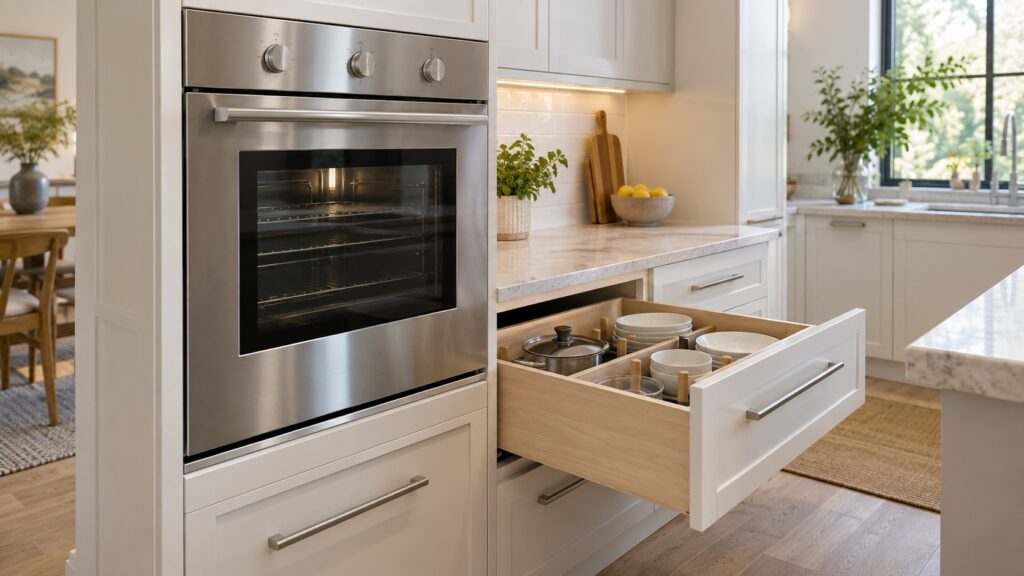
A speed oven is designed to sit in a wall cabinet, usually stacked with or beside a wall oven, at roughly chest height. That makes it easy to see into and keeps hot food away from the floor, but it also takes a precious wall-oven-sized opening that you might want for a conventional oven. The cutout, the electrical supply behind it and the ventilation space around it are all specific to the model, so your cabinet maker needs the manual and not an estimate.
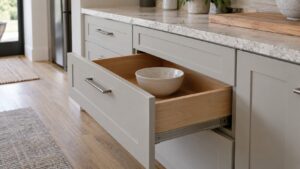
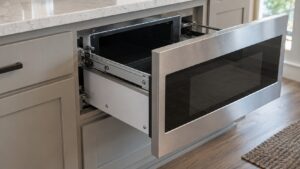
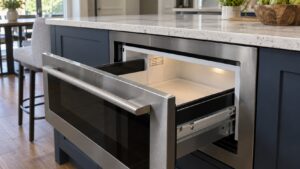
A microwave drawer goes under a counter or into an island, which frees up wall space and keeps the microwave out of sight. The trade-off is that it needs a base cabinet of the right width and enough depth behind it for the drawer mechanism. Our Wolf microwave drawer installation guide covers what the opening must provide, and our MDD30 vs MDD24 comparison helps you pick the width.
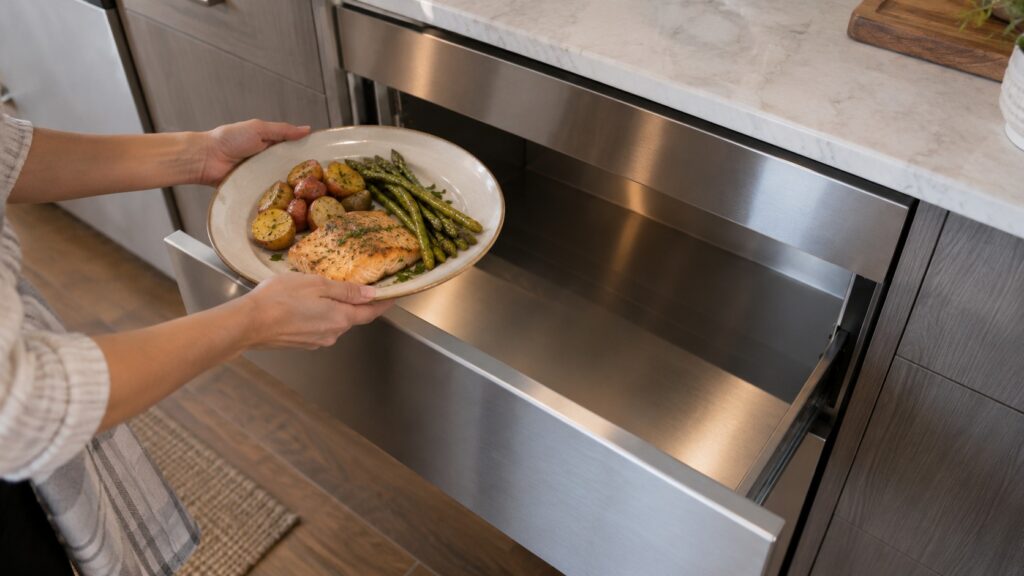
How do they cook differently in daily use?
Think about the three or four things you actually do with a microwave. If the list is reheating plates, defrosting, warming milk and steaming a bag of vegetables, a drawer does all of it without a learning curve. If you also want a baked potato in ten minutes, crisp-edged reheated pizza, or a small roast without heating a large oven, the speed oven gives you results a drawer cannot.
The speed oven rewards learning. Combination cooking means you choose how much microwave and how much convection to use, and recipes written for it are different from the instructions on a frozen dinner. Some owners love that, and some find it more than they wanted. Be honest about which kind of cook you are before you spend the money, because a feature you never touch is not a feature.
Which is easier and safer to live with every day?
Ergonomics favors the drawer. You look down into it, slide a heavy dish in at counter height, and lift it straight out without reaching over an open door. For anyone with limited reach or strength, that matters more than any cooking feature. The drawer is also easier for a child to use, which is a point in its favor and a reason to use the control lock if you have little ones.
The speed oven wins on visibility and versatility. At eye level you can watch browning, and an open door does not block your path the way a drawer does. It also gets hot on the outside during convection cooking, so anyone loading it needs oven mitts, which a microwave-only drawer never requires. Neither appliance should be used empty or with metal that is not approved for the mode you have chosen.
What goes wrong with each, and how hard are they to service?
Both appliances contain a high-voltage section that stays dangerous after the power is switched off, so neither is a do-it-yourself repair behind the panel. The common faults differ. A drawer relies on a motor, tracks and door sensors, so the usual complaints are a drawer that will not open, will not close fully, or will not start. Our Wolf microwave drawer won’t open guide covers that group. A speed oven has more parts that can wear, including the convection fan, heating element, door latch and control, so a fault can be harder to pin down.
Neither is unusually unreliable, and neither needs special treatment beyond a clean interior and sensible use. If either misbehaves, our Wolf microwave repair page explains how a visit works. Our wider Wolf microwave buying guide is a good companion if you are still deciding between formats.
What should you check before you order either one?
Write down the full model number from the dealer’s sheet, including the finish suffix, and compare it with the model page and the installation manual before anything is cut. Confirm the opening size, the power supply and the clearance for the door or drawer. Ask your installer where the outlet will be and whether the cabinet allows the appliance to open fully without catching a handle or a neighboring door.
Then decide what you will stop doing. A speed oven can let you skip heating the big oven on weeknights, and a drawer can clear a countertop. Whichever you choose, keep the manual and the serial number together where you can find them; they save time on every future service call.