
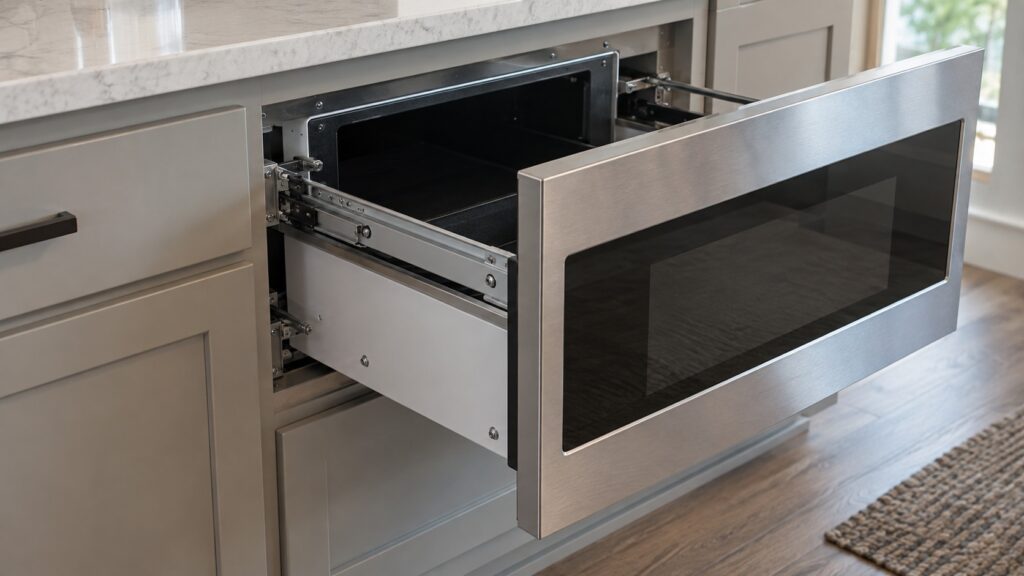
A Wolf microwave drawer rides in and out on a pair of telescoping rails instead of swinging open on a hinge, and that mechanism is exactly what most microwave maintenance advice never mentions. Wolf MDD track maintenance is a short, separate routine from wiping down the interior or checking the door seal on a standard microwave, because a drawer’s failure points are mechanical — rails, rollers, and the motor that drives them — long before they are anything to do with heating.
Why does a drawer-style microwave need different maintenance from a door-style one?
A hinged microwave door has one moving joint and a rubber-and-mesh seal to keep clean. A drawer has an entire slide mechanism carrying the full weight of the cavity and its contents in and out on every use, and that mechanism sits directly below the cavity floor — the one place spills and crumbs are most likely to end up. Wolf MDD track maintenance exists as its own topic because the failure points are mechanical wear points, not heating or sealing points, and they get overlooked by anyone following generic microwave cleaning advice.
What actually accumulates on the rails, and where does it come from?
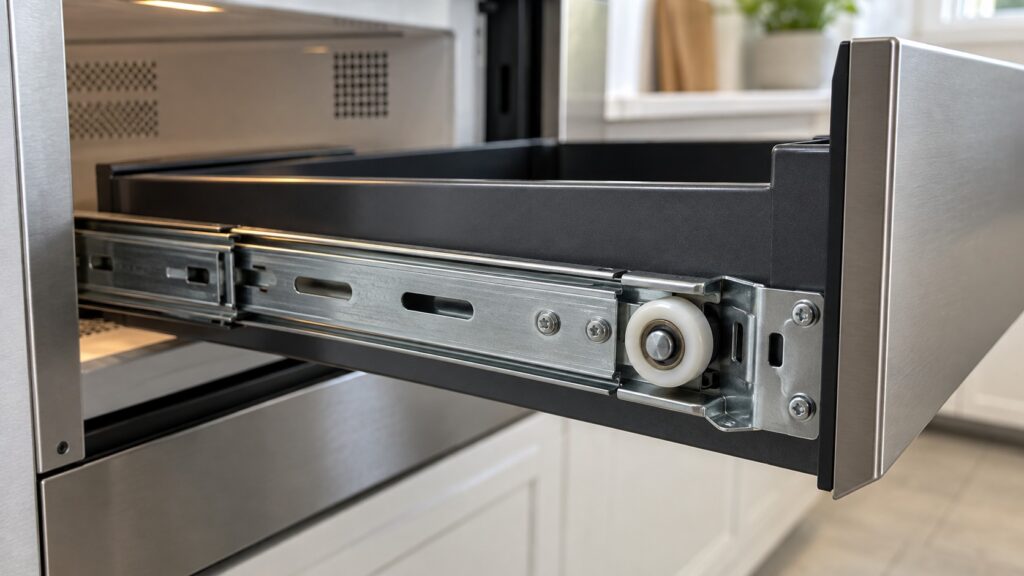
Grease from reheated food and crumbs from anything that spills during loading or unloading both migrate downward and settle into the rail channel along the sides of the drawer opening, not just the visible interior floor. Over months of regular use this builds into a light film that changes how smoothly the rollers move, and it is often mistaken for a motor problem when it is really just resistance from buildup in the track.
How should the rails and rollers actually be cleaned?
Open the drawer fully, unplug the unit at the outlet, and wipe the visible length of each rail with a damp cloth and mild dish soap, working crumbs and grease out of the channel rather than pushing them further in. A soft brush — an old toothbrush works well — reaches the corners where the roller wheel meets the rail better than a cloth alone. Dry the rails completely before closing the drawer or plugging the unit back in, since trapped moisture in a channel this close to the motor housing is worse than the crumbs it is meant to remove.
Why should silicone spray or grease stay off the rails?
It is tempting to lubricate a drawer that feels stiff, but silicone and grease-based lubricants attract dust and food debris rather than shedding it, which turns a temporarily smoother motion into a stickier one within weeks. Worse, on models where a motor drives the open and close motion, added lubricant can change how much grip the drive mechanism has on the rail surface. If a drawer feels genuinely stiff after cleaning rather than dirty, that is a sign for inspection rather than a home lubrication fix.
How often should this actually be done in a household that cooks daily?
There is no fixed factory interval published for rail cleaning, because it depends far more on how the drawer is used than on a calendar. A household that reheats plates and mugs sees light, gradual buildup and can go a couple of months between checks without trouble. A household that uses the drawer for anything that tends to splatter — sauces, soups, anything reheated without a cover — should check the rail channel every few weeks, since that kind of use is exactly what accelerates buildup in the track. The practical rule is to check after any spill that reaches the drawer’s edge, rather than waiting for a fixed number of weeks to pass regardless of how the drawer has actually been used.
It also helps to get in the habit of a quick visual check whenever the drawer is open for another reason — pulling it fully open to load a large dish is a natural moment to glance at both rails before closing it again. Catching a thin film of grease early, before it has a chance to bake on from repeated reheating cycles, takes a fraction of the time that a heavier buildup takes to remove later.
What symptoms mean the track has gone past a cleaning fix?
A drawer that grinds, catches at the same point every time, or has started sitting slightly crooked when fully open usually points to a worn roller or a rail that has shifted out of alignment rather than debris. Our Wolf microwave drawer won’t open or close guide covers the diagnostic steps for that stage, separate from the routine cleaning covered here — cleaning fixes buildup, not a worn or bent mechanical part.
Is there anything about the front panel itself worth checking at the same time?
While the drawer is open for a rail cleaning, it is worth wiping down the push-to-open latch mechanism on the front panel as well, since the same crumbs and grease that reach the rails often collect there too. A latch that feels less responsive than usual is more often a cleaning issue than a mechanical failure, and addressing it during the same routine saves a separate inspection later.
Does this maintenance apply the same way to both drawer widths?
Yes. The rail and roller mechanism is essentially the same design across the MDD, MD and MWD drawer families regardless of whether the unit is a 24-inch or a 30-inch model — our Wolf microwave drawer glossary entry covers how these model families relate to one another. The cleaning routine described here applies equally whichever width and finish is installed.
If a drawer that has been cleaned still runs rough, or the front panel no longer responds consistently, it is worth having the mechanism inspected before it wears further. Installation clearance also affects long-term rail wear, and our Wolf microwave drawer installation guide covers the cabinet opening tolerances that keep a drawer running true. We are an independent repair service, not a factory-authorized channel; Wolf microwave repair covers rail and roller replacement when cleaning alone no longer solves it, and you can schedule a visit when you are ready.