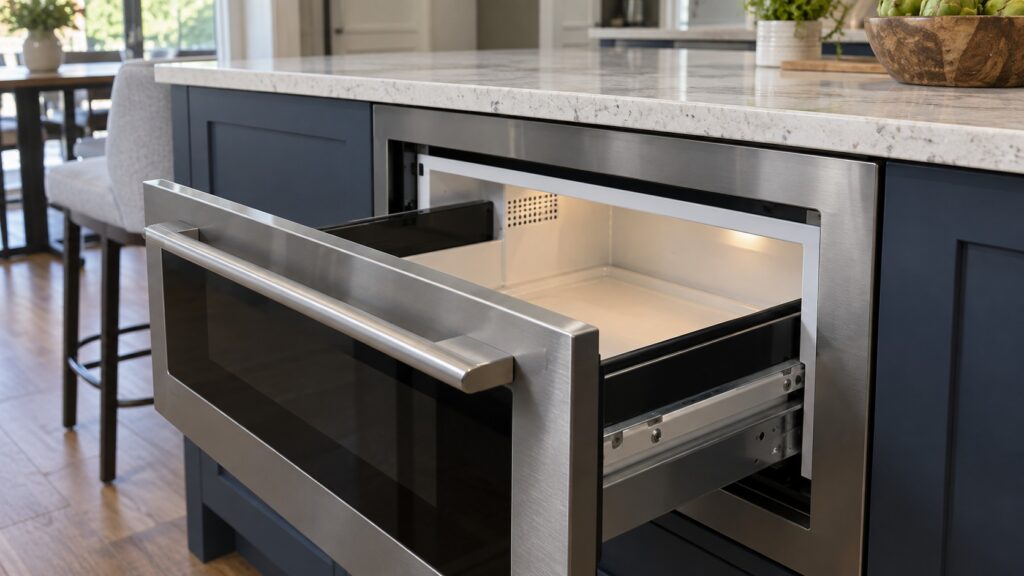
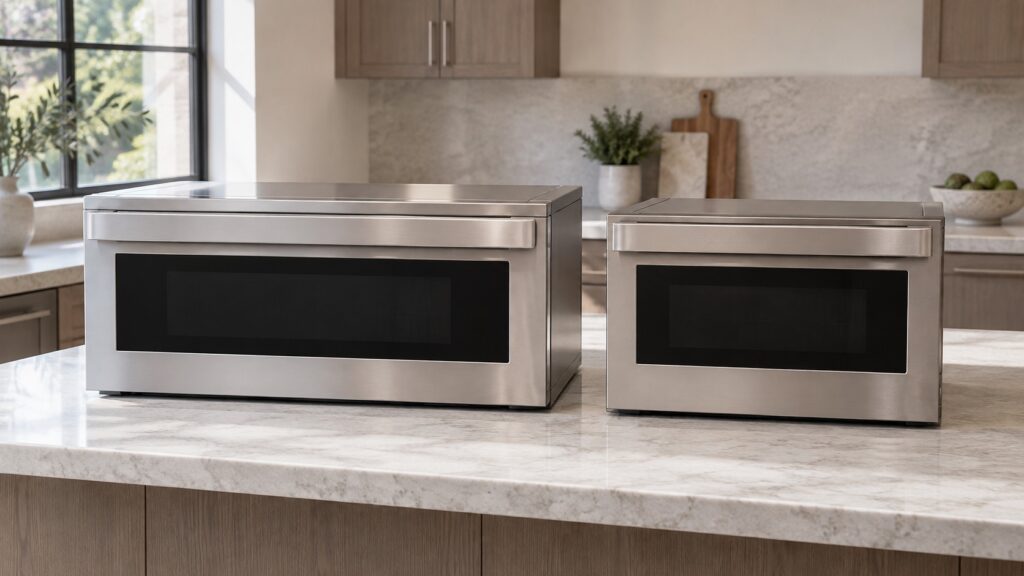
Wolf sells its drawer-style microwave in two widths, and the choice between an MDD30 and an MDD24 comes down to how much interior volume a kitchen actually needs, not which one looks better in a showroom photo. Both drop into a base cabinet or a tall column, both open with a push on the front panel instead of a swing door, and both carry the same touch controls. The difference that matters is what fits between the cabinet openings a kitchen designer already drew, and what the household actually reheats and cooks day to day.
What actually changes between a 30-inch and a 24-inch Wolf microwave drawer?
The control panel, the push-to-open latch, and the sensor cooking programs are identical across both widths of the wolf mdd30 vs mdd24 microwave drawer decision. What changes is the interior box: the MDD30 gives roughly a third more usable floor area inside the cavity, which shows up as the difference between reheating one plate and reheating two plates or a full casserole dish at once. If the household regularly warms side dishes for a dinner party, or the drawer will double as the only microwave in the kitchen, that extra room stops being a convenience and becomes the reason to buy the wider unit.
Does the MDD24 save real cabinet space, or just look smaller?
Six inches of width sounds minor until it collides with a run of drawers below a cooktop, or a narrow pantry column that was never meant to hold an appliance. The MDD24 exists for exactly that situation: a kitchen with a tight galley layout, a small second kitchen in a guest suite, or a stack where the microwave drawer sits below a warming drawer and above a refrigerator drawer. In any of those spots, six inches is the difference between a design that works on paper and one that has to be redrawn. If the cabinet run already has 30 inches free and nothing else competing for it, the width saving buys nothing.
Which one handles a real dinner load without reheating twice?
The most common regret with the smaller drawer is not a missing feature — it is running two heating cycles because a dinner plate and a side dish will not both fit inside at once. Households that entertain, or that use the microwave drawer as backup cooking capacity during a holiday meal, are almost always better served by the MDD30. Households that use the drawer mainly for coffee, oatmeal, or a single reheated plate rarely notice the smaller cavity at all, and the MDD24 does the job without asking for the wider cabinet opening.
How does the price gap compare with the space you get back?
Pricing on both widths starts from a few hundred dollars apart, with the MDD24 the less expensive of the two; the exact figure moves with finish and current promotions, so treat any number here as a starting point rather than a quote. What the price difference buys is capacity, not a different control system or a longer parts list — both drawers share the same touchpad, the same drive motor design, and the same service parts family, so neither width carries a meaningfully different repair profile down the road.
What do the suffix letters on an MDD model tag actually tell you?
Once the width is decided, the rest of the model number — the letters after MDD30 or MDD24 — describe finish and handle style rather than capacity. A separate breakdown of those suffixes lives in our Wolf microwave drawer model number glossary, which covers the stainless, black glass, handled, and handleless combinations in detail. It is worth reading before ordering, because the suffix on the data plate is what a parts counter or a technician will ask for first.
What should the cabinet opening look like before either width arrives?
Both the MDD30 and MDD24 need a dedicated rough opening sized to that specific model, proper airflow clearance around the vent, and an outlet placed where the drawer’s own cord can reach it without stretching across the cabinet interior. Getting this wrong after the cabinets are built is expensive to fix, so it is worth reviewing the framing dimensions before ordering either width. Our Wolf microwave drawer installation guide covers the clearance and electrical requirements for both sizes in more detail than a spec sheet alone will give you.
Does the wider drawer take longer to preheat or cook a full load?
Sensor cooking programs on both widths adjust automatically for the size of the load rather than the size of the cavity, so a single plate in the MDD30 heats about as quickly as the same plate would in the MDD24. The extra time only shows up when the extra space is actually used — two dishes side by side in the MDD30 naturally take longer than one dish alone, simply because there is more food to bring up to temperature, not because the larger cavity itself is slower to respond.
When does a repair make more sense than swapping widths?
A drawer that has stopped opening smoothly, lost heat, or developed a control panel that no longer responds is not, on its own, a reason to change widths. Most of those symptoms are ordinary parts failures — a worn drive belt, a failed magnetron, a sticking latch — and they get fixed the same way whether the unit is a 24-inch or a 30-inch model. Before assuming a width swap is the only path forward, it is worth having the existing unit looked at; our technicians are an independent service, not a factory-authorized channel, and we will tell you honestly when a repair no longer makes sense against the cost of a new drawer. Diagnostic visits start from an upfront estimate, confirmed before any work begins.
If a drawer at either width needs attention now, or a new installation is still in the planning stage, Wolf microwave repair covers diagnosis and parts for both the MDD30 and MDD24 lines, and you can schedule a visit with the model number from the data plate ready to go.