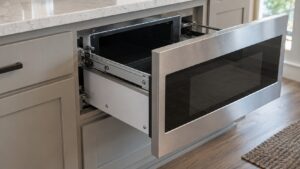
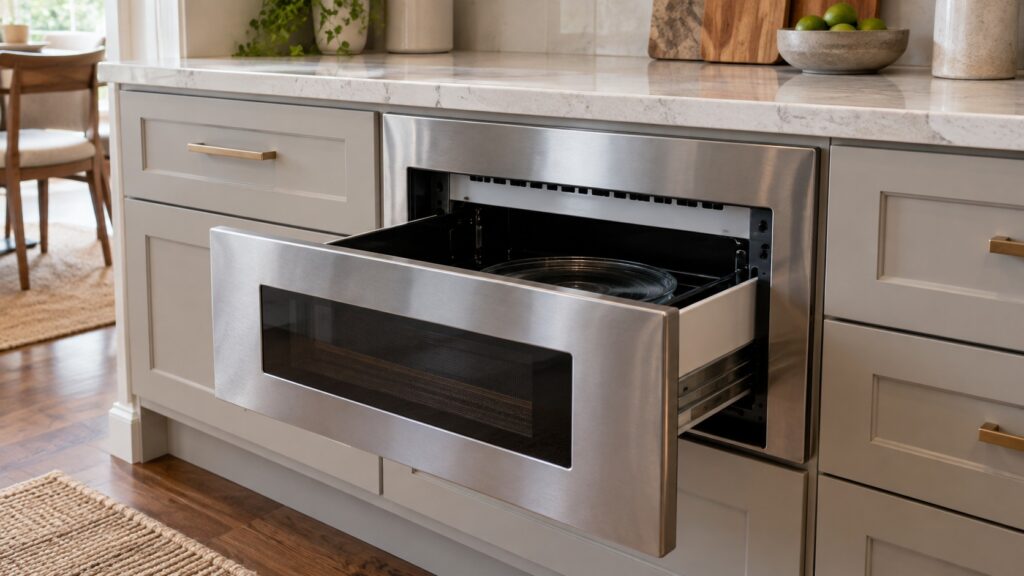
A Wolf MDD3050 microwave drawer number is not a random string: every block in it answers one question. The letters say what kind of microwave it is, the first two digits say how wide the opening must be, the pair after them says which generation of trim it belongs to, and the suffix after the slash says what the front looks like. Read left to right and a number like MDD3050PM/S/P tells you the cutout, the handle and the panel before you have opened a single specification sheet.
What does a Wolf MDD3050 microwave drawer number break down into?
Take MDD3050PM/S/P apart in four pieces. MDD is the drawer family built to sit under a matching oven. 30 is the nominal width in inches. 50 marks the trim generation the appliance belongs to, and it is the block that ties a drawer to the ovens it is meant to be installed with. PM is the trim and control treatment. The tail, /S/P, describes the front: stainless, with a professional handle.
The same reading works on the neighbors. MDD3050TE/S/T swaps the professional trim for a transitional one and ends in a tubular handle. MDD3050CM/B/T is the contemporary treatment with a black front. MDD30PM/S/PH is an earlier number in the same family, shorter because it predates the 50 block.
This is what separates this page from our glossary entry on the Wolf microwave drawer, which explains what a drawer microwave is and why people choose one. Here the subject is the number itself, because that is what is stamped on the appliance and typed into a parts search.
Where do I find the number on my own drawer?
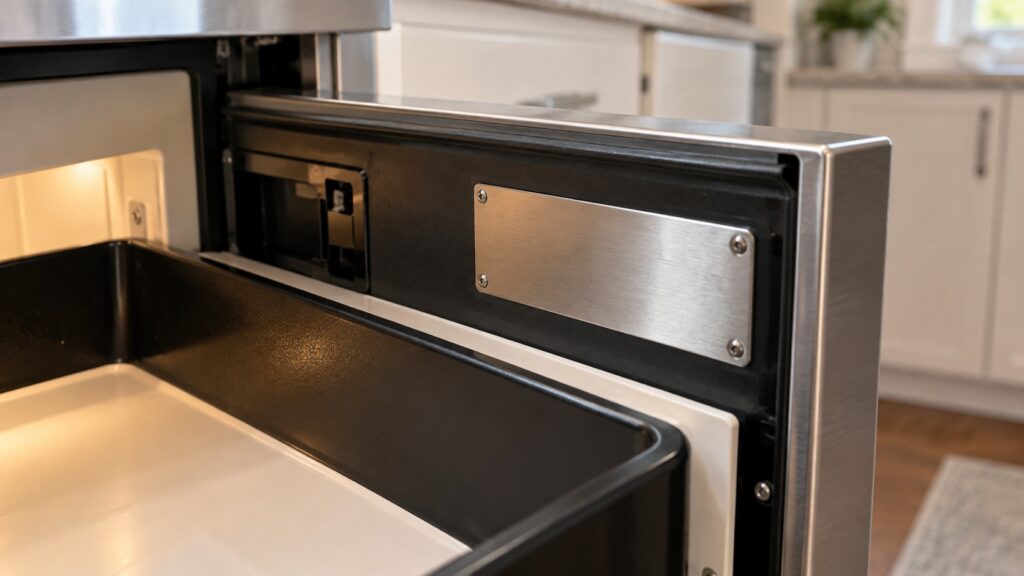
On a drawer microwave the rating plate is not on the front, which is why so many people search a partial number. Pull the drawer fully open and look at the upper edge of the cavity opening and along the inside of the drawer front. On most installations the plate is visible only with the drawer out and a flashlight held at an angle.
Copy the whole string, including the slashes. The part before the first slash identifies the appliance family; the parts after it identify the front. Two appliances that differ only after the slash share almost every internal component, which is why a technician can often work from the first block alone — but the full string is what tells a parts desk which door assembly and which handle to send.
If the drawer will not open far enough to read the plate, that is its own fault rather than a mystery, and our guide on a Wolf microwave drawer that will not open or close covers why.
Does the width in the number tell me it will fit?
It tells you which family to shop in. It does not tell you the appliance will drop into the hole the old one came out of, and that is the single most expensive assumption in a kitchen project.
Three things move independently of the nominal width:
- Cutout height. Drawer generations differ in how much vertical space they need, and a later model can be taller than the one it replaces even at the same width.
- Depth behind the face. A drawer slides, so it needs clear space behind the cabinet face for the mechanism, not just a box the size of the cavity.
- The stack above. An MDD number exists because the drawer is designed to sit in a column with an oven. Replacing only the drawer in an existing stack can leave a trim gap that no filler strip hides cleanly.
So treat the width digits as the first filter and the installation dimensions as the decision. Our microwave drawer installation guide sets out what has to be measured before anything is ordered.
What do the letters after the width mean for parts?
The trim block is where service and shopping part company. Two drawers that differ only in trim letters will usually take the same magnetron, the same drawer motor and the same door switches, because those live behind the front. What changes with the letters is everything you can see and touch: the panel skin, the handle, the control overlay and in some cases the control board that drives a different style of interface.
This has a practical consequence for anyone ordering a part from a photograph. A handle that looks right is not necessarily the right handle, and a control panel that matches visually may carry a different membrane. The tail of the number is the only reliable way to order a visible part, and it is the part of the number people most often leave out of an email.
It matters for matching, too. If a kitchen already has an oven in professional trim, a drawer ordered in transitional trim will sit under it looking almost right, which is worse than looking clearly different.
How is a drawer different from an MS24 or MC24?
MS24 and MC24 are built-in microwaves rather than drawers, and the difference is not only the door. A drawer opens downward and is loaded from above, so tall containers go in easily and the appliance can sit below the countertop within reach of anyone. A conventional built-in swings open toward you and is normally installed at eye level or in a wall oven stack.
They also fail differently. A drawer has a motorized mechanism, a set of position switches and a rail assembly that a swing-door microwave simply does not have, and those are the components behind most drawer service calls. A conventional built-in is more likely to present as a heating fault or a panel fault. If you are choosing between the two, our Wolf microwave buying guide compares them by how they are used rather than by number.
What does the number tell a technician before a visit?
More than most people expect. The family block says whether there is a drawer mechanism involved at all. The width says which cavity and which door assembly. The trim block dates the appliance closely enough to know which control generation is inside, and that determines whether a fault is likely to be a board, a switch or a mechanism.
When you call, read the full string from the plate rather than describing the appliance. A Wolf MDD3050 microwave drawer and an MWD30 of similar age look nearly identical in a kitchen photograph and share very little in the parts list.
We are an independent repair company, not a factory service arm. Pricing starts from a diagnostic visit and we confirm the estimate before any work begins. Call (844) 991-2780 with the number from the plate, or schedule a visit and our Wolf microwave repair service will bring the parts that match the string rather than the photograph.